Nature journaling can be done however you wish and whenever you wish. My initial thought was to return with my nature journal to Agua Caliente Park in Tucson in the fall. However, my recent walk allowed me to see three brown-crested flycatchers.
Brown-crested flycatchers are here in southern Arizona in the summer. I heard their call, believing I knew their call, and kept looking for them. Finally I saw the butt-ends of them on a branch! Crazily I am asking them to turn around so I can be sure of my observation and identification. No quick accommodation was provided me! Interestingly they were holding their wings out to be in a cooling pose. Here I was wishing I had brought my camera to photograph this scene … and then, the larger bird, dove for something and returned to the branch. Ah yes, it was what I thought … brown-crested flycatcher!
With a small young one present I wondered if I could find their nest. I did not. All birds in the mid-summer, mid-day heat were not moving fast so I had plenty of time to observe the 2 on the branch and another one flying in the area. I sketched and added some colored ink to the drawings. Nothing is accurate, but a reminder that the birds were here in August.
Another bird, cactus wren, I wanted to include here since I had not seen it last month. Supposedly here during the year, I don’t always catch sight of them. This month though, I did! The usual vermilion flycatchers were enjoying the hot day, but others not so much. As a result, I had to look into grassed-over wetland areas and thickets. By the time I was done I saw 15 different species! Will be back in the fall and see what I observe then. Till then, stay cool and hydrated … humans and birds!
Bird festivals are all over the USA and some in Europe. If you have never attended a bird festival, here are some of the reasons I enjoy attending them:
Meet people from all over the USA and sometimes from other countries. Everyone has a story about how they began to be interested in birds. Or a story about their “spark bird”; the first bird they saw and encouraged them to look for more birds.
Field trips are organized. Some trips the transportation to the birding location is provided. This is especially helpful when I am visiting the area; someone else is doing the driving to the location. This is an option also at my local festival. While traveling to the location it is more time to chat with my fellow birders. Or, some field trips we meet our guide at the trailhead.
Field trips out at sea are the best with a group and guide. Know that those boat trips fill fast!
Field trips in my local area are valuable because more eyes are looking for birds compared to the day I am the only one looking for birds. Notice also, the group size is usually a small number so register as soon as you are interested in a field trip before it closes out.
The guides at festivals are amazingly knowledgeable! Many hear the bird call/song and can identify the bird. Also, many guides carry a viewing scope to share the observation of a bird. I’m using my binoculars, but there are times the viewing scope has a better magnification on the bird. Often I look through the scope to see where in the tree or bush the bird is and that allows me to find the bird in my binoculars.
Infrequently a guide will try to call a bird in, for educational purposes, thus not abusing this practice. As a result, we have had success calling a bird closer to us so we could see it more easily than not. We knew the bird was somewhere within the bush’s leaves and now the bird popped out on top or off to another branch and more easily seen.
Guides provide information about the habitat a bird needs and often knows the flowers or other animals in the area.
Often, I will observe a new bird for my “life list” of birds. That is exciting, especially since I know others saw the bird too and the identification is correct. Real helpful if that bird is only found in a specific location!
Workshops are presented by photographers, birding companies from around the USA and world, such as Columbia and Brazil. Or guides share their destinations, such as Scotland, Ecuador, Costa Rica and that they are available in their home state. Photographers always have absolutely amazing photos capturing birds in flight and explaining to the rest of us how it can be accomplished, with what type of equipment and patience!
Vendors are at the nature expo area with binoculars, viewing scopes, cameras and lenses and all kinds of things a birder may be interested in trying out and/or purchasing. Here’s a place to also spend time talking with representatives of birding companies and personal birding guides.
Finally, you hear about other birding festivals and may consider attending one of them in the future.
Overall, I have really enjoyed attending various bird festivals. If you have never attended one, give one a try. Maybe it’s one closest to your hometown. You’ll be amazed how many birds you will see in a day with the help a guide and everyone else in your group even if it is your hometown!
Will you see this bird? Don’t know till you show up … check out a bird festival within the next year.
A wash is more obviously a riparian area when water is in it. However, in the desert that doesn’t happen often enough! Actually when the monsoon is truly heavy with rain water, the wash overflows and floods the local road. I love when that happens. The desert needs the rain. But on this day, we are walking in a very dry, sandy wash! It’s an early morning birding adventure. Our goal is to observe birds before the air temperatures climb to a triple digit! Let’s get out of the wash before then!
I love birding with other people and a guide who almost always knows more than the rest of the group. So many human eyeballs looking for birds! The birds were smartly hiding within the tree leaves as the crazy humans looked for them while standing in sun or shade, yeah, when available.
Where are the birds?
When you first look at a wash, such as the one we were at, one can wonder if we will see any bird. Yet we did see! Twenty-eight different species of birds were seen, 106 individual birds! I was fortunate too to have observed a bird new to me, a rufous-winged sparrow! A new bird for my life list!
I loved having access to our guide’s viewing scope to get a great look at a blue grosbeak, lark sparrow and bullock’s oriole. While I have very good binoculars, these observations went to the next level. Plus having the guide’s expertise in knowing exactly what the bird was that we were viewing in the scope.
We had a productive 2 hour morning and then on our way to air-conditioning and cool drinks! Heat exhaustion and dehydration are real concerns with our latest hot weather, so 2 hours was plenty for us. The birds seem to find places to escape the heat and enjoy water features since our monsoon has not provided rain for wildlife. Hope it rains soon!
Final note: we don’t only observe birds. Some of us check out plants. Often we’ll see lizards and on this day there was a king snake crawling across the trail:
Honeybee Canyon Park was only explored halfway today in our Arizona heat despite starting at 6:30am. I joined birders attending the Southeast Arizona Bird Festival on this hike. We did see many different bird species.
You really do walk in the wash of a canyon at Honey Bee Canyon Park. Shaded by the canyon walls, saguaro and mesquite trees we could spot various birds. They too were deep within some branches or on the ground scratching around.
Honey Bee Canyon Park
We identified most birds with the help of our guide and also used iNaturalist app for the lizards we observed. Merlin Bird ID helped with bird songs we heard, when we could not see the bird. Some of us took photos of the habitat, specific plants and animals so we include them on the desktop version of eBird. There are new categories in the media section per checklist. I will be curious if they accept the downy feather of a great horned owl we found trailside. Our guide said great horned owls are definitely here, despite us not seeing one now.
Downy feather from great horned owl
This canyon had a few dams built around 1890. Ranchers wanted to hold some water. One remaining dam now has a walkway through it so we could walk more of the wash. I can imagine the importance of water then, just as it continues to be a concern in the 21st century!
A remaining dam with walkway through.
We observed an uncapped pipe which can be a death trap for animals. The location was forwarded to an individual we know who caps pipes such as this.
Pipe in front needs a cap!Ways to close death pipes.
In the winter, I’ll visit this park again to see petroglyphs and wildlife that time of year. I’m sure to have memories of this hot morning with a nice group of birders.
Nature is happening just on the other side of your window. Why not take note of the life happening out there? Your journal could be a written list of your observations. Or a sketch, a painting, an audio file …however you wish to record your observations. Next year you may compare this year’s observations with that. I suspect some people have numerous years of observations recorded in some fashion and compare a year to another for a location or another.
Or you could step outside! Whether it is your backyard, your front yard, or a favorite local area, you could journal what you observe there. It need not be every day. Maybe once a month. Possibly when you notice plenty of activity at a time. Or a compilation of what you had seen during the month. It’s your decision: when, how, where … I encourage you to enjoy the activity, whatever you choose.
Our backyard has busy days with birds and other wildlife running through. So I simply try to capture the various animals beyond our usual birds. If I was real ambitious I would be sketching some of the plants finally blooming! But, my goal is to combine some personal relaxation time with sketching time and enjoy what critters are in our backyard. Here’s a bit of what happened in July in our backyard:
I thought of adding watercolor paint, but I really don’t want to complicate my goal … especially my relaxed state. This is also my usual tea time … 10:30am … and it’s all for fun! I hope I do look back on this page next July … that would be very cool! Are you taking time for yourself to enjoy moments in nature?
Walk among the ponderosa pine trees. Look toward the south rim of the Grand Canyon. Enjoy a beer at the saloon. A meal or ranger presentation at the Grand Canyon Lodge on the North Rim. Drive the Cape Royal Road to Point Imperial or to the end of the road. All now memories, the North Rim of the Grand Canyon will never be as it was! It was with great sadness I learned of the initial July 4 wildfire jumping the “control and contain” lines. This had been the practice of handling wildfires. A week later though, a place I was to visit in 2 months, was destroyed. Yes, the plants will grow and the animals will return in time. But the historic structures, the main lodge and cabins built by Mary Colter, are part too of the catastrophic loss.
Lightning strikes happened on the north rim many times and some were allowed to continue to burn. However, with a drop in the Arizona humidity and wind the fire spread so fast. Iconic and historic buildings are gone. Hopefully the animals could seek shelter someplace. No human lives were lost. There was another wildfire further up the road that prompted evacuation from the rim. There is only one road in and out from the rim so fortunately people were evacuated then. The Dragon Bravo fire caused the devastation at the north rim. The park will be closed for the 2025 season. So many people have been displaced or lost their homes and/or jobs with the park now closed.
Ways to donate: there are a couple GoFundMe fundraisers. Grand Canyon Conservancy set up fundraiser called Grand Canyon Disaster Recovery Fund. The money collected by the official non-profit partner of the Grand Canyon National Park cannot provide monies to individuals. It will help with the rebuilding and restoration of the north rim. Loaner equipment and temporary housing may be the first efforts once the wildfire is contained. There will be years of work ahead. Donate what you can, if you can. Thanks. Grand Canyon Disaster Recovery Fund
Here are some photos from our last visit to the north rim of the Grand Canyon:
Lightning strikes happen other years, but not always with conditions to create a wildfire.
Loved looking into the canyon!
Unfortunately the “pioneer cabins” are destroyed in the wildfire.
Wildlife on our last hike on the north rim … hopefully they could move to safety during the fire.
Finding fossils, observing lichen, and walking in areas where few people visit was fun!
Looking into the canyon from Cape Royal.
Only a fraction of the number of people visiting Grand Canyon National Park travel to the north rim. It is a 4 – 5 hour drive from the south rim to the north rim. If you have been lucky enough to visit the north rim, share your memories here. I would love to hear what you enjoyed while at the north rim. Someday the north rim will be open again and I will be there!
Nature, the animals, plants and world around each, is a joy for me. Thus, I spend time whenever I can in nature. Recently I decided I should journal some of the observations made while I am in nature. Maybe even chronicle some locations on a regular basis. Here is my first nature journal from a local park, Agua Caliente in Tucson, Arizona this month. As my nature journal grows, I’ll see what I discover about nature and my art with hopes you’ll find something interesting too!
Colorado’s beauty is in its natural landscape. Between the mountains, open landscapes, creeks and rivers, all often bordered with sweet yellow clover, there is a calm. Enter a small or larger town and the frenetic pace of life kicks in with one wishing for the quiet space once again. This is how I felt driving from Walsenburg to Cortez.
Thankfully Wolf Creek Pass and miles between towns were calm as was where I spent last night outside of Pagosa Springs. As I mentioned in the previous post, I appreciated this Harvest Host location at 84 Ranch. Only the wind. Even the cows in the field were silent! It’s wonderful to escape life’s noises every so often. I wish I could bottle this silence. Plus there is no cell service so I can completely unplug from the world events. Time to think, meditate, read, write, sketch and simply be! The sun did go down and the stars were huge!I wish everyone could have this experience. It’s a shame they cannot.
A view!
My sketch
Next morning I visited Chimney Rock National Monument, located between Pagosa Springs and Durango. It was designated a national monument in 2012 and is one of only 14 managed by the US Forest Service. I took the Great House Trail tour and learned the ancestral Puebloans were most aware of the moon’s location between Chimney and Companion Rock every 18.5 years. Sites like this continue to be spiritually significant to Native Americans. Please always treat these sites with respect. Always.
Moon aligns between the rocks every 18.5 years!
The next day, while in Cortez area, I visited Canyon of the Ancients National Monument. My first early morning stop was at Lowry Pueblo and guaranteed to have the place to yourself. Canyon of the Ancients was designated a national monument in 2000 and is managed by the Bureau of Land Management. During the month of September, the Bureau of Land Management provides special recreation permits for the public to also use the land. This is very different than land managed by the US Forest Service which does not provide that option.
Canyon of the Ancients National Monument encompasses 176,000 acres and so far there are 8300 documented sites with ancestral Pueblo artifacts. Archeologists think another 10,000 sites are possible on this land. Be sure to stop at the visitor center and view the couple of films, the museum and the Escalante Pueblo, a short walk up a paved trail. I cannot help but notice what great locations these pueblos are at with 360 degree view. No doubt it was for defensive positioning. Looking across the sage plain and to the far away mountains also provided a place of beauty.
Amazing rock wall building of a side wall!
Escalante Pueblo by the Canyon of the Ancients visitor center, another place to visit!
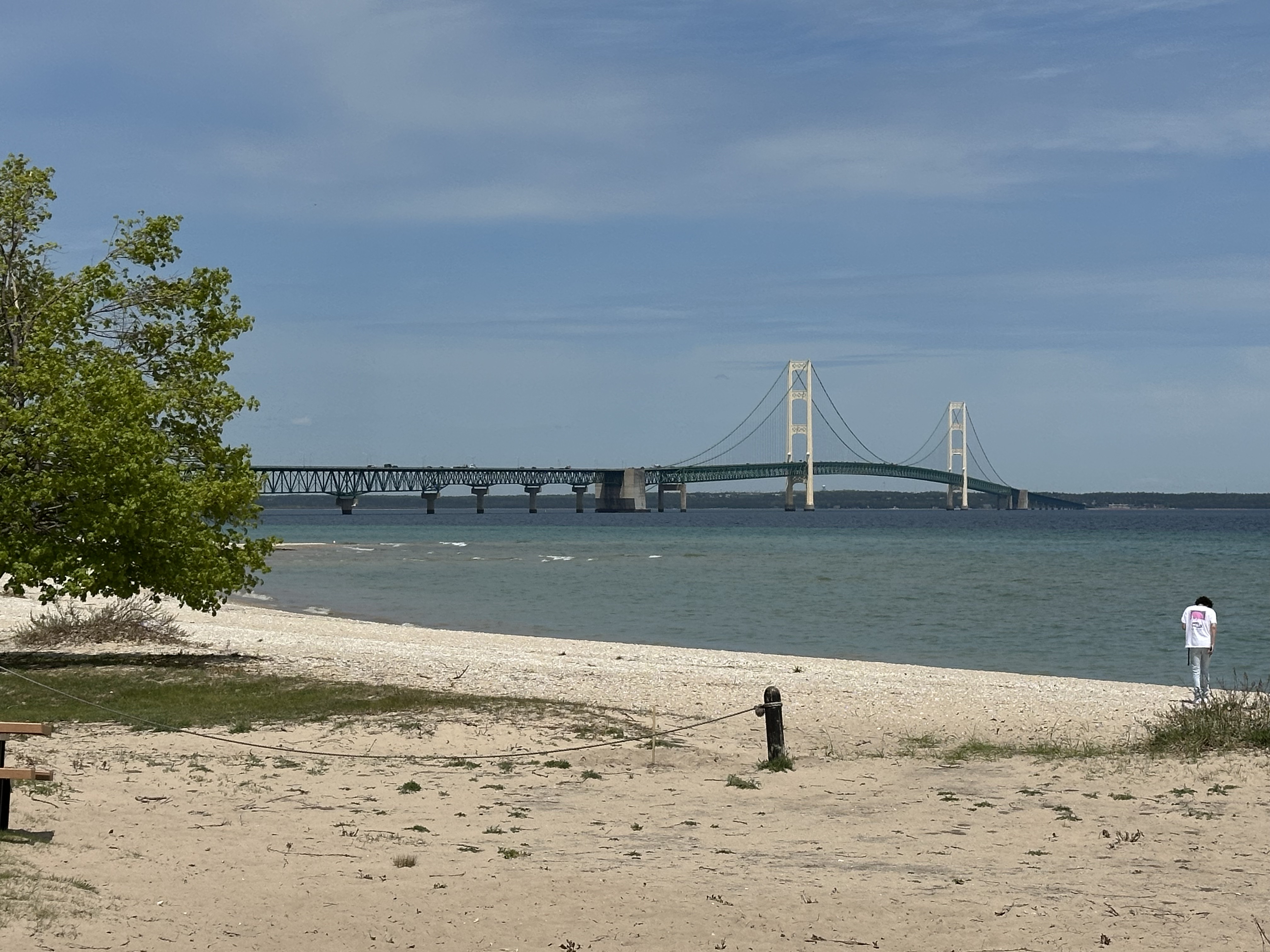
Michigan’s Mackinac Bridge is about 5 miles long, longest in the Western Hemisphere and 5th longest in the world. My research states: the bridge does not sway with wind, but there is a gradual shift … up to 35 feet at the center span! That strikes me as amazing! I really need to look further for a better understanding.
Cross the bridge from Mackinaw City to Saint Ignace and you are on the Upper Peninsula of Michigan! Here Lake Michigan meets Lake Huron … exactly under this bridge!
Mackinac Bridge … travel north to Upper Peninsula!
A memory:
Two years ago I was birding at a wooded rest area in Virginia. A guy and I got talking. He mentioned he and his wife live in the Upper Peninsula of Michigan. I said, some day I will get there. When I returned to my van and put my camera away, I discovered a piece of paper tucked in the window of the driver’s door. He left their names and phone number. Of course, I filed it in my phone.
Now I am here on the Upper Peninsula (UP), known as “Yooperland”. I called their phone number and left a message thanking them for their note. When I met him, he had recommended Seney National Wildlife Refuge, thinking I may be interested in visiting there, having seen my interest in birds at the VA rest area. I put that in my notes too. Amazingly I received a phone call from them! With their input, I created a more specific plan for my days on the UP. They were surprised to have heard from me two years later, and I was happy their phone had a recorder for messages!
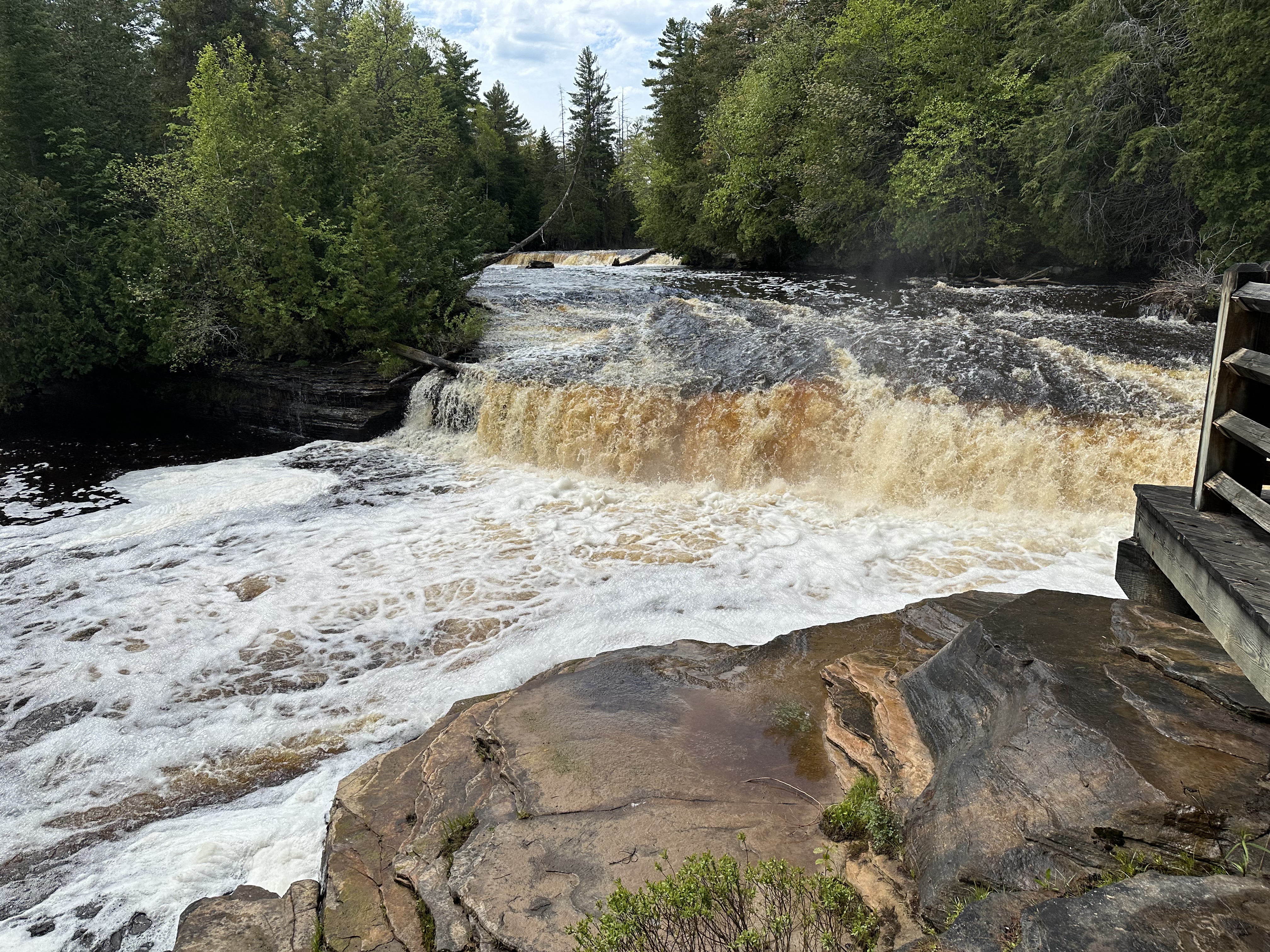
Day 1: After buying groceries and gas for the van, I headed off to Whitefish Point. Great place to walk the sandy shore, collect stones, see the oldest operating lighthouse on Lake Superior, and visit the Shipwreck Museum. Next stop was at Lower, (1/2 mile hike) and then Upper (3/4 mile hike) Falls at Tahquamenon State Park. Beautiful scenery and not many people on the trails. Mosquitoes and black flies were out, but in the woods not a problem. First impression of the Upper Peninsula, it is beautiful!
Lower Tahquamenon Falls
Upper Tahquamenon Falls
I drove the 7 mile scenic dirt road at Seney National Wildlife Refuge. Loons, sandhill cranes and many trumpeter swans were seen. I’ll return in a couple of days again to spend more time.
Day 2: Relaxed morning until I saw my weather app indicating rain in 10 minutes. I flew out of bed and made my coffee and tea just before the rain. Enjoyed breakfast then in the comfort of my van!
Pictured Rocks National Lakeshore is best seen from a boat, so I boarded the Spray Falls catamaran for a 2 hour cruise. We’re on the northern shore of the Upper Peninsula on Lake Superior. Our view is looking back on the sandy beaches, wind and water-carved cliffs with the various colored rocks. The first part of the journey is basically calm in the harbor. On the lake however, waves started to kick up with our catamaran rocking side to side. I’m not sure if I am enjoying this at the moment!
A small section of Pictured Rocks National Lakeshore
Halfway through the tour, the captain turned the catamaran around to return to our starting point. We’ll receive a half price refund. The captain doubted the next cruise would go out since 7 foot swells were expected. Correct, that cruise did not go out. I’m glad I saw what I did and dressed appropriately! The temperature is 20 degrees colder on the water and with the wind it was about 35 degrees when on the cruise. I was freezing! Also appreciated the boat being turned around as it felt dicey to me.
There are so many waterfalls on the Upper Peninsula to see and some are just off the road, such as Alger Falls! You can pick up a map of waterfalls in the area. Some waterfall trails are closed due to damage to the area after this winter. I used my AllTrails app and discovered a nice hike to Miners Falls. Beautiful trail amongst the trees! Definitely walk to the lower observation point to see the entire falls!
Miners Falls
Day 3: This was my Marquette day to visit their Saturday downtown farmer’s market. Locals all seemed to be buying plants, especially tomato plants. I grabbed a breakfast burrito and eventually found Dead River Coffee Roasters, a few blocks away. There I bought Brazilian and Nicaraguan coffee beans ground for my French press which I use on the road. While walking the downtown area, I bought a blueberry muffin at Babycakes. Next door was the store and gallery, I heard about on a CBS Sunday Morning program a year or so ago. The photographer had taken a sunrise photo each day since 2019. The “Sunrise Gallery” was amazing and he continues to take a daily photo. I bought one photo taken on my birthdate in 2021.
Onward to Presque Isle Park. I loved this park! Free parking, 6 miles of hiking trails and if it was not so cold, a place for a bicycle ride. A dedicated bike path hugs the shoreline for miles and through Marquette area. It was 35 degrees this morning and now just barely above 50 degrees … and who really knows the temperature with the wind blowing … so I was not bicycling! I did also visit Little Presque Isle where you need a recreation pass to park. No need to stay, I was happy to have already hiked enough at Presque Isle.
Day 4: Seney National Wildlife Refuge is huge on the Upper Peninsula. The chances of me photographing a loon with a tag on it or seeing the oldest male, aged 38 this summer, are slim to none. However, I heard about ABJ, the male loon having been banded as a chick. The bird returned again this year, late April. Plus a female loon, Fe, pronounced “Fay”, banded as an adult will turn at least 39 this year. They are an international couple and have birders wondering if ABJ will meet up with his longtime mate Fe. My eyes are peeled looking for a common loon with an upper broken bill … that could be ABJ … and believed his beak was broken in a territorial fight at some point! ABJ has returned here for decades, this wildlife refuge is huge, and yet I will spend hours observing any and all birds here!
Amazingly, I saw a few loons and I think I have a photo of a loon with an orange band on its leg. Now to find out where to send my photo and the details they need. I loved being at the refuge.
Orange band is visible on this loon!
Perfect bills so not ABJ and Fe
Wondered what they were communicating to each other.
Ohio’s Coastal Trail became my go-to, rainy day activity as I visited places along Lake Erie and wished the rain to stop! In Arizona I would have loved to see all this rain. In Ohio, with my hopes of observing migrating warblers during my 2 days here, I was not a happy camper! Time to be flexible…
The first day I arrived at Magee Marsh; the only wild shore and marsh in northwest Ohio. I walked the entire bird trail. Many people were here also because in 5 days the big birding event will be happening here. Specifically, people from all over the world are also wanting to see the migrating warblers. I had no plans to attend the event, since I had more travel ahead, but hoped to see a new warbler for my life list. Day one, no new bird.
Day two: pouring rain last night and expectation of rain all this day. As it was raining in the morning, I chose breakfast with coffee at a local restaurant … no sense trying to battle the cold and wind to brew my own coffee! If you’re in Perrysburg, Ohio, stop in Hang Over Easy for breakfast or lunch … good food!
I decided to drive east, then backtrack west along Lake Erie’s coastline to return to Magee’s Marsh. White-caps were on the lake. Cold, blustery wind and probably the fastest sight-seeing I had ever done. First, Marblehead Lighthouse, since 1822, … impressive building, but closed. I learned it is one of Lake Erie’s most – photographed landmarks. During the summer you can climb the 77 steps to its top for a good view of the lake and Marblehead Peninsula.
Marblehead, OH lighthouse
Second, Great Egret Marsh Nature Preserve. I discover it is a Nature Conservancy property. I walked the overgrown 1.2 mile trail. No one thinks winter is over here to mow it quite yet. I saw some birds … egrets, herons and strong fliers coping with the rain and wind.
Great Egret Marsh Preserve
Third, restored Port Clinton’s historic lighthouse from 1896, active for 30 years and decommissioned in 1952. It is the shortest lighthouse, 26 feet, in Ohio. If you are in the area, their annual celebration is August 16, 2025.
Port Clinton, Ohio lighthouse
Finally Magee Marsh! I stopped at the visitor center. There are excellent displays and worth a stop. By the time I walked a section of the bird trail, it stopped raining!! For about an hour, on a half mile section, here are some of the birds I saw. Unfortunately, no new birds for me!
Black-and-white warbler
Blue-headed vireo
Northern parula
Next day I drove to Presque Isle., further east on the Lake Erie coastline. A couple I met, at the campground I stayed, told me of a coffee-chocolate place, Romolo’s Chocolates. Of course, a hot mocha hit the spot after another day’s driving in the wind and rain. (I mention wind because with a van I feel every gust!) Anyway, plenty of chocolate to choose at this one-and-only place. A guy in the parking lot jokingly asked if I drove all the way from Arizona to this chocolate place in Erie, Pennsylvania … no, but almost! He kindly gave me a map of Presque Isle and I headed off in the wind and rain! In between raindrops, I hopped out to see what birds were around. Not many! Hardy red-breasted mergansers for the most part.
The Tom Ridge Environmental Center was my next stop since I usually have good weather and skip stopping here. But with the lousy weather, it was good to step indoors and see their displays. Really nice place and I walked up their tower which allows you to look out over Lake Erie from this part of its coast. No warblers are going through here, except for yellow warblers and yellow-rumped warblers. So many warblers are migrating on the western coastline of Ohio, not here. However, many terns, mergansers and diving birds are here.
North East, Pennsylvania has about 14 wineries in the area. My Harvest Host location for the night was at one. Apparently there is a microclimate that does well for growing grape vines … who knew? And now you know!