We crossed Lake Wakatipu from Queenstown on a historic steamship, TSS Earnslaw, to Walter Peak Station. The steamship was in service for 57 years and now used for pleasure cruising. (I will say for a person who easily gets motion-sick, the cruise across the lake was smooth and not a problem for me.) We arrived at the Walter Peak Station where our tour group had a buffet-style farewell dinner. Many other tourists were also here for dinner and just like us also for the “farm show”. This place is beautiful, in a lovely location and the dinner was delicious! I truly did get my fill of lamb meat at dinners on the New Zealand portion of my travels.
TSS Earnslaw Steamship
Coal was shoveled in to run the steamship.
Walter Peak Station … where we arrive!
Dinner … buffet-style and delicious food!
The “farm show”, included the shearing of a Merino sheep… happy to be rid of the warmth of the wool it was carrying on its body! Merino sheep are only sheared one time a year. It’s spring time here and this sheep was ready for a shearing! This man did a very professional job shearing this sheep!
Not one knick to the sheep!
The “farm show” continued with a short-haired Border collie and its owner demonstrating how the dog herds sheep simply by his voice commands. That dog can run! Before I knew it, the dog was running uphill to the peak and herding the sheep for their movement down the hill. It was truly impressive how the dog responds to the commands and the sheep were moved into a pen within 3 minutes. I wish you could have seen it!
Short -haired Border Collie
We had time to walk the property which included wonderful vistas, other animals and flowers, and lots of open space! I loved being able to absorb the beauty of it all, reflect on my time in New Zealand, and ready myself for the long flights home. Back on the steamship, we sang as the piano player banged out at least 30 different songs! It was fun, but I was also ready to go home!
Farewell New Zealand!
As my blog posts continue, I may think about specific incidents to share and write. I know I will hold many more memories than what has been written these past weeks. To travel “down under” to Australia and New Zealand had been life-long dream that has now been realized. I am fortunate and grateful to have been able to fulfill this dream. May I wish you the same with your dreams! Dream on!
We visited Arrowtown, an 1862 gold rush town, a short drive from Queenstown, New Zealand. Our walking tour included discussion of its gold mining history and the arrival of the first Chinese immigrants to New Zealand. By 1865 the first gold rush was over and many left for other goldfields. With fear of a collapsed NZ economy, Chinese miners were invited to New Zealand. The Chinese had hopes of making money and returning home. By 1871 the Chinese outnumbered the European miners on the goldfields.
Like other gold rushes around the world, many flock to an area, work hard, live in poor conditions and hope to strike it rich. Housing and working conditions varied for workers. The Chinese laborers were miners and builders of various places, homes and bridges within this town, though they lived in tiny, tin and adobe shacks compared to the Europeans who hired them. The town now has the restored remains of the Chinese settlement a distance away, as they were in the cold shadows of the mountains. On a couple of main streets are restored Victorian style houses and quaint shops; many parts of the town are now protected Heritage sites.
Ah Lum’s Store, now restored; private property is next door.
New Zealand’s population is just over 5.5 million people, predominately on two main islands: North Island and South Island, yet technically it is made up of over 600 islands. Besides New Zealand’s beautiful landscape, I felt a beauty in their heart. I say this because there was recognition of Māori language in signage throughout the country and an appreciation of wild land and wild life.
To take one example, we stopped at a bird sanctuary. Notice the languages on the sign:
Notice languages and the bird
Punanga Manu o Te Anau … Te Anua Bird Sanctuary … has the only surviving population of takahē, a flightless bird once thought extinct. They were rediscovered in 1948 in the Murchison Mountains nearby. The once captive breeding program hand-reared the chicks; however, now eggs are left on the nest for the adult takahēs to rear.
Takahē bird
New Zealand’s goal is to be predator-free of rats, stoats and possums by 2050. Currently they have more than 110 predator-free islands so native species can thrive. Unfortunately it was human-introduced pests that preyed on the island’s wildlife causing some to go extinct. Now New Zealand works to get its native wildlife back by 2050.
I also appreciate the effort by New Zealanders to include Māori language on signage throughout the islands. While this may seem a small thing, Māori are the second largest ethnic group in the country, at almost 18%, and deserve recognition, especially as travelers visit the country. I understand efforts continue to acknowledge the history of this country as we, in the USA, have similar work to complete with our Native Americans. May the work continue to save and respect wild and human life.
We drove through the center of New Zealand’s North Island, the epicenter of Maori life, to Rotorua. It was a long drive broken up with some interesting stops along the way. We passed beautiful green fields and hundreds of dairy cows. Dairy is the number one industry, except in 2019 it was tourism. China is the largest importer of the dairy from New Zealand. We have already enjoyed “hokey pokey”, vanilla ice cream with honey bits in it; delicious!
Our tour guide shared historical information as we rode along. The long and short of it: Abel Tasman and Captain Cook eventually discover this area of the world. New Zealand was once a state of Australia; however, in recognizing that Australia did not have New Zealand’s interest at heart, New Zealand became part of the Commonwealth of England.
Our first stop Hamilton Gardens: a public garden on the banks of the Waikato River. We roamed the gardens and enjoyed lunch here also. There were many themed gardens. Enjoy the photos:
Hamilton Gardens-Italian Gardens
Kumara (sweet potatoes) planting at Hamilton Gardens
Fantasy Garden at Hamilton Gardens in NZ
Tudor Garden at Hamilton Gardena
As we continued on our way to Rotorua, we stopped at the Nest Egg Kiwi Conservation Project facility. New Zealand’s national bird is the kiwi, which comes from the Māori language meaning “hidden bird”. Kiwis are nearly extinct in the wild so the nation has doubled down on conservation efforts with nest egg teams across the islands. The work here at this place is amazing, plus the country has set aside predator-free islands so the bird can survive! We had a tour here where they explained every step of their finding kiwis in the wild with their conservation dogs and transmitters on male kiwis.
They have 120 conservation dogs that can sniff out a kiwi, but are trained to then sit and back away for a conservation person to go to the nest the male kiwi has been sitting on. They only collect the eggs, possibly 2, once the male kiwi has been on it for 60 days. They have incubators at their facility to handle the final 18-20 days … even with machines that turn the eggs each day! Once the egg hatches, they rear the young kiwi till it is about 2 pounds in weight and return them to the area they picked up the egg. The eggs are huge! It’s about a third of the female’s body size and when I held the model egg, I would say about 6 times the size of a chicken egg.
Kiwis are small birds and since they are nocturnal we could only see them in the dark. The facility purposely sets up the kiwi’s day and night cycle so visitors can see them at their visit. No photos are allowed, but at least I saw 3 real kiwis. The staff report a high success rate in their breeding, raising and caring for the kiwis …. that was good news!
What a kiwi looks like…
Did you know to refer to the fruit as kiwi fruit … not just kiwi, that is the bird. In the USA, we often see the green kiwi fruit. Here I had a golden, sweeter-tasting, kiwi fruit at one of my breakfasts. Also, I learned kiwi fruit is actually not from New Zealand! Learn something new everyday!
How could I travel to Australia for 3 weeks and not fly three hours to visit New Zealand for a couple of weeks!?! No dice! So, I joined another Overseas Adventure Travel (OAT) group in New Zealand and a friend of mine joined me here! Grateful!
We had a couple of days in Auckland to visit the War Memorial Museum, Auckland Art Gallery, walk the streets in the university area and for me to also bird in Albert Park. My first New Zealand bird is the New Zealand fantail. This bird was almost impossible to photograph as it hopped around in the middle of tree branches. But I at least got its butt-end with the fantail!
New Zealand fantail
Our group stopped at Bastion Point and the Michael Joseph Savage Memorial with a discussion of the Māori traditions and right to the land. Their struggle continues. They need to be recognized as the “first people” with an understanding of the history that their land was taken from them. The history of how the Treaty of Waitangi was signed on February 6, 1840 between the Māori and the British and yet the British continued to displace the aori people through to the 1970’s. The British colonization for those hundred plus years, with continued land theft from the Maori, came to a head in 1975 when the cry was “Not 1 more acre!” with a land march to Wellington. Tents were pitched in 1977 for 502 days at Bastion Park regarding the issue of what reparations the Maori people deserve as a result of the historical grievances. However the reality is, the Treaty of Waitangi document led to a discriminatory impact on the country’s Maori population who continue to experience disproportionate poverty. Our Maori local guide obviously did an excellent job presenting the info and these are my quick notes from that talk. My overall understanding was the Maori never had any intention of the British ruling them. Now dependent on the political party in power in New Zealand, the Māori have made some gains in recognition, yet with the current governing party there seems to be less progress.
The next day we ferried to Waiheke Island, New Zealand’s second largest island, about 40 minutes from Auckland. Gray, light rainy day as we were driven by van around the island, stopped at some beaches, then to a small winery, Casita Miro, and an olive oil estate, Allpress. I did hear a tui, unfortunately no photo of the bird. I am hoping it is common enough to catch a photo in upcoming days as we go to Rotorua… or I just might sketch one.
At Casita Miro you can see the Spanish influences made at this winery with the mosaic tiles and murals around the property and the wines produced here. This winery is one of 30 wineries on the island. I enjoyed their blend, Miro, and their port, Madame Rouge.
Mosaic wall as one drives up the driveway
After 6 wines to taste, we had this delicious lunch to share.
Tasting room at the winery
At Allpress, an olive oil estate we learned about the extra virgin olive oil they produce from the 7,000 trees, 10 varieties all from northern Italy. I learned that olive trees are self-pollinating so one only needs to have 2 trees for success and that it takes 14 pounds of olives to produce 1 liter of olive oil! Their olive oil is delicious; $100 to ship 6 bottles, so I passed. This is when you wish you lived closer!
Video and then she presented the oils.
I laid low for the rest of the evening and relaxed. I usually do not use any motion sickness patches when on a boat or ferry and can see land and/or horizon in the distance. But even with that short ride of 40 minutes each way and other islands around to see, my head was “rocking with the waves in my brain” hours later. This is when I really appreciate a good night’s sleep! Thankfully tomorrow’s a new day!
We flew from Melbourne, 5.6 million people, with its urbanscape and numerous green gardens to the red sand, salt flats and red-dirt roads near the small town of Alice Springs, 25,000 people. Our first stop was the Historical Telegraph Station. In 1872, Europeans settled in Alice Springs and established the Overland Telegraph Line to relay messages between Darwin and Adelaide using Samuel Morse’s code! Long story regarding the name of Alice Springs, but suffice it to know, Alice never made it here and there is no spring.
We visited Anzac Hill Lookout, a memorial for all Australians who fought in wars and a place to look out on Alice Springs. I remember reading about Anzac biscuits put in the comfort parcels that families sent to their military men in Australia and New Zealand. The eggless biscuit is made from rolled oats, flour and golden syrup are still popular in Australia. I have not seen one yet. We are not going into the town’s center because of recent street violence. I’m sure we’ll here more about it to understand the current local conflict.
Northern Territory flag
Australian Aboriginal flag; official status granted 1995
We stopped at a “bottle shop” where people can buy alcohol. The shop is open limited hours and closed Sunday, Monday and Tuesday. There is a limit of what you can buy per day. Police check identification at the drive thru area or your identification is checked if you opt to walk in the store to make your purchase. If you have any infraction on your license you cannot buy alcohol.
Tonight we had our dinner at a local golf club and played lawn bowling. Similar to bocce but with a ball, called a bowl, with the goal for one to roll it toward and end up closest to a small white ball, a “jack”. The bowls though have a bias. This means they are heavier on one side causing it to curve when the ball/bowl is rolled. Very interesting trying to determine the best way to roll the bowl. Fun game!
The next day we drove further into the Desert Outback and stopped at Simpson’s Gap in the West MacDonnell Mountain Range. The red cliffs and landscape, along with the warm temperature reminds me of Sedona, Arizona and Moab, Utah. Plenty of hiking and biking trails in this area. For the longer Larapinta Trail, only experienced hikers should be on it.
Simpsons Gap
Simpsons Gap
Standley Chasm is a geologic formation where traditionally only women were allowed to visit. In this area, they would collect bush medicines and perform sacred rites. It is a private aboriginal property and business. There is the trail to the chasm and you’ll end where it is sacred land and you can go no further. Also a cafe and caravan/camping area.
Stanley Chasm
End of trail at Stanley Chasm
We drove back to Alice Springs. Here’s a peek at what the scenery looked like when we were not looking at red rocks:
A few of us visited the Royal Flying Doctor Service. To be honest, I became aware of these individuals while watching a PBS television program by the same name! I loved the work they in the story were doing and added it to my list of places to check out when in Australia. Here I was visiting their museum and yes, there will be additional tv series. Anyway, there are now 73 planes in the Australian territories dedicated to the health care and emergencies; apparently the flying doctor airlifts 8 Territorians every day. The service also provides dental care, telemedicine, and education so all have access to good medicine.
Note how specific you are notifying the emergency care when you request care.
Inside the plane with all the medical team’s needs.
In the heart of the Outback is a 100 acre sustainable living center where we enjoyed dinner. After selecting a drink, we saw “damper” being made. It was bread made by Australian aboriginals, yet the recipe we were shown was modernized with beer added to self-rising flour and raisins. It was not thrown into hot coals as once done; oven on site was used. The resulting bread was a thick, homemade bread… simple! Our dinner was beef and chicken with roasted potatoes and pumpkin, salads and sticky date for dessert. (I must find out how to make the sticky date dessert as I loved it!)
We were shown a “swag”. It is a rolled bedroll and when laid out you are on a comfortable mattress and able to enjoy star-gazing for hours on end. Unfortunately the clouds were here and we had no stars to see. A musical instrument was also shown, yet I missed those details. Overall, a good visit at Earth Sanctuary where they have groups, school groups and others attend to learn about sustainable living, camping and star-gazing. Another great day comes to an end.
Damper is being made here.
Listening to our Earth Sanctuary Guide. Unfortunately clouds arrived by the time we wished to star gaze with him.
Onward with our travel in Tasmania from Cradle Mountain to Launceston which has many 19th century and Victorian-era warehouses still standing. We visited the Platypus House Wildlife Center. Here we saw these unique duck-billed animals close-up. Each platypus has its own pond, yet one female, Dawn, would sometimes slip through a tunnel to visit a male platypus, Jupiter. When it’s breeding time the staff will see how well the two will get on; otherwise a platypus is usually solitary. Tasmanian platypus are biologically distinct from those on the mainland due to their isolation here.
We also saw echidnas. They and the platypus are monotremes meaning they have a single opening for urinary, defecatory and reproductive systems. While the platypus were swimming in their ponds, the echidnas were walking around our feet. The echidnas have unbelievably long tongues as we watched them eat! The platypus and echidnas here at this facility are animals that cannot return to the wild. This is not a rehabilitation place, solely here for educational purposes.
The duck-bill of the platypus is closest to the window to help you know one end from another on this unusual animal.
Echidna being fed; notice its back feet!
Echidna with 15 centimeter long, sticky tongue out.
Our lunch was at a boutique winery, Small Wonders. A delicious charcuterie board and a glass of the locally produced wine or two, as you wish. The vineyard was well pruned no doubt in prep for this spring and summer growth. Beautiful property. It truly is a first spring weekend for everyone so this winery was very busy.
Small Wonder Winery in Tasmania
While in Launceston, we rode the “longest single span of any chairlift in the world”, 308 meters at Cataract Gorge which was carved for thousands of years by the South Esk River. It was a beautiful, easy, short walk as we looked below to rushing waters from the winter’s snow. Yet last night there was snow on the nearby mountains. It’s been cold in Tasmania and I am “rugged up” every day.
Cataract Gorge
Voting in Australia is compulsory. On that day a “sausage sizzle” is available for free to everyone voting. It is a piece of white bread with sautéed onions and a sausage. You can top it with sauce, BBQ sauce or mustard. Of course, we all tried one! Officially, the food is layered with white bread, then sausage, sautéed onions and sauce … or maybe it was bread, onions, then sausage and sauce … quite the discussion between the vendor and our guide as to which is the official way to serve the sausage sizzle. Whatever, we ate it!
The United States had benefitted from their allies, and the troops from Australia and New Zealand, when fighting in World War I and II, Vietnam and Korean War. April 25th is when Australians commemorate the loss of their people in various wars and conflicts around the world and it is called ANZAC Day. One statue where a commemoration would take place on the 25th:
On another note: it is good to see signs such as this:
Finally, we had to see the Fairy or, now officially known as, the Little penguins! We headed to Low Head with an arrival time as the sun was setting in anticipation of the penguins returning to their burrows for the night. They are about 12 inches high and weigh one pound. They are dark blue on their back and white on their belly, perfect for the time they spend in water. Predators above and below them will not see them. They eat about a half pound of fish every day, a good food supply here at the Bess Strait. Breeding will begin in September with the majority of the penguins mating for life. Two eggs are laid, usually 2 – 4 days apart, with the incubation lasting 35 days. Both parents share that responsibility. Our guide provided plenty of information about these little penguins which were so fun to watch! It was very cold and windy for us as spectators, but we watched the penguins as they marched off to their burrows. No flash was allowed so the photos are not the best, but hopefully you can spot the penguins. We fly to Melbourne next…
“Gday!” is the “good day” greeting and all people I have met so far are very pleasant with a “Gday” as a hello! I am in Tasmania, one of Australia’s 6 states, about the size of Switzerland, or California is 6.5 times larger, or Arizona is 4.5 times larger, or about the size of West Virginia. About 575,000 people live in Tasmania and about half live in Hobart. (Besides the 6 states, there are also 2 territories in Australia.)
Away from the city of Hobart is Bruny Island. The weather was not good for an anticipated harbor cruise, so an inland day tour at Bruny Island sounded like an okay idea. We headed off with a quick ferry ride from Tasmania’s mainland to Bruny Island where about 500 – 1,000 people live year-round. The tour included a few stops off the main road on the island.
Our first stop was a cheese-making business. We tasted 4 different cheeses while learning about each cheese and drinking a whey stout beer they also produce. The cheeses were delicious and so was the beer … all enjoyed at 10:00AM. Seems like a good start to a day!
Our next stops: “The Neck”, a skinny area of land where we could observe plenty of water around this island. Then off to walk in a rainforest at Mavista where the ferns were huge and hundreds of years old. It almost had a Jurassic Park feeling as plants and trees were tangled within and all felt thick. Back on the main road and within town, I was surprised to see a white wallaby on a person’s front yard. Only on this island will you find white wallabies.
White wallaby
Wallaby
Lunch, another stop: I had my first oyster-tasting experience … 3 fresh oysters with drops of lemon juice on each. They were okay, but the fish and chips meal was even better. My favorite stop was the chocolate shop. My piece of fudge was deliciously consumed! The owners of the business also have a private garden we could walk through. Most interesting was 25 acres of English flowers and landscaping style with the other 25 acres with totally native plants.
Final stop: honey. There were at least 15 different bottles of honey to taste, along with face and hand creams, and 2 different mustards. We left with a sample bottle of honey and honey-flavored ice cream.
Throughout the day I was looking for birds. Amazingly I found 11 new birds.
Laughing kookaburra
Pied oystercatcher having “lunch”
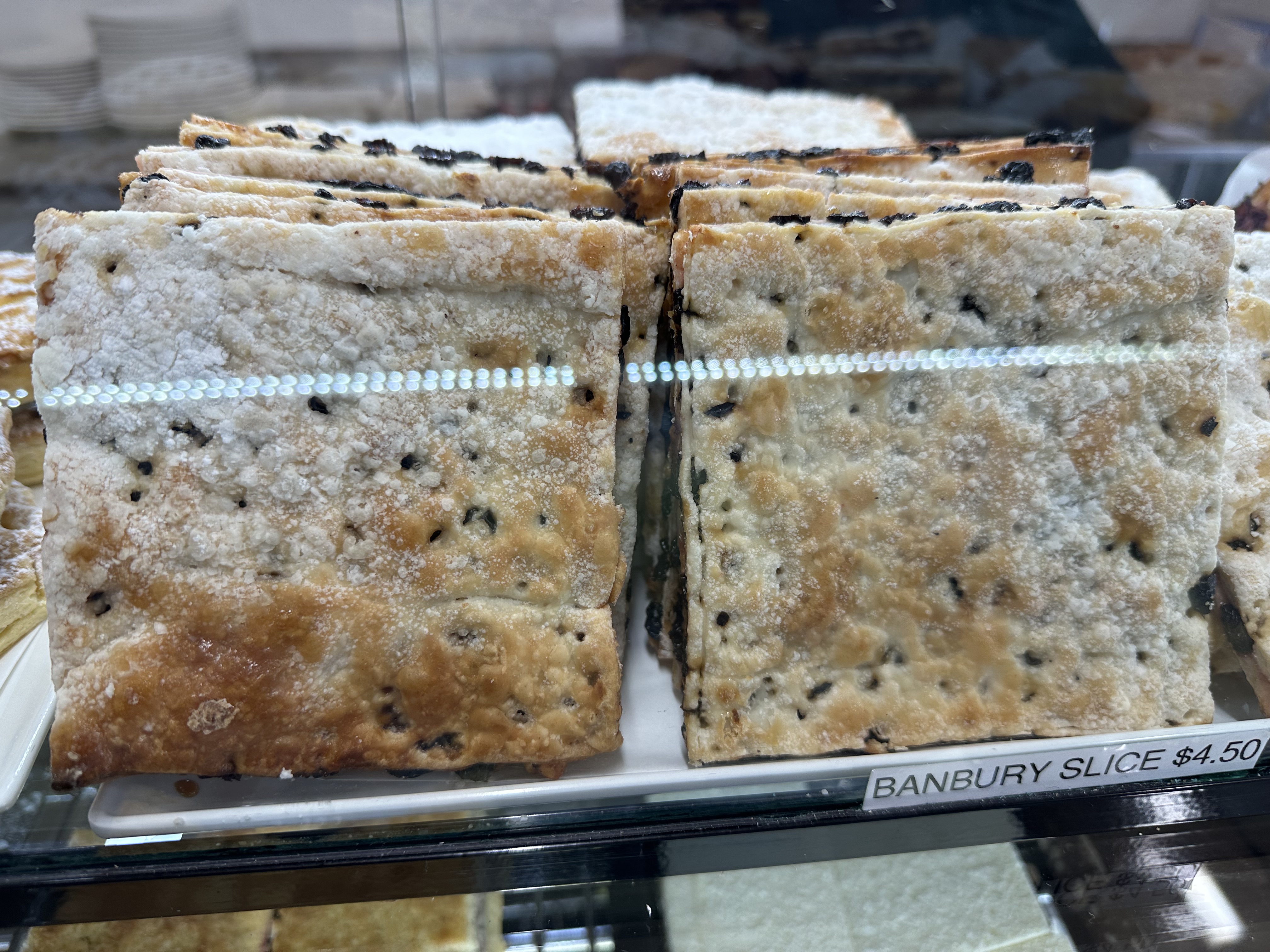
The next day we left Hobart for our upcoming night’s stay at Cradle Mountain Hotel, within the Tasmanian Wilderness World Heritage Area. Along the way we stopped at a few small towns. Our first place to stretch our legs was in the town of Ross where two of us shared a tasty, currant-filled Banbury slice. See photo below:
Banbury slice
In Campbell Town, we spent time reading bricks. Each brick listed the name of a convict, their crime and years sentenced. If a female convict was to marry, her sentence was no longer. The townspeople got the info for the bricks from the ship manifests that brought the convicts to Tasmania. These bricks line the roadway on 2 sides of the main thoroughfare.
Deloraine was our next stop for lunch and again to stretch our legs. Cute sculptures were on corners. I was also looking for a red telephone booth and this is what I found:
Need to call someone?
Any one can make a free local phone call from a red telephone booth in Tasmania. How important it is to reach out, for whatever reason, and get help when you need it … just a phone call away. Coincidentally this day was also “RUOk Week” or “are you okay week”. Our guide’s boss texted our guide to ask “are you okay” and our guide asked our driver if he was okay. Very cool!
Finally we arrived at Cradle Mountain Hotel. Just before dinner I saw my new bird for the day, a Black Currawong!
My travel home to Arizona from Idaho was a direct route. I camped in the Provo/Springville, Utah area; however, wildfire smoke and heat kept me quickly moving south. First though, I wanted to meet my continued goal of finding a new place to visit, so I stopped at the Springville Museum of Art.
Wow, this museum is impressive! The community is celebrating its 100th Anniversary of the Spring Salon. In the 1920’s, Springville High School students hung their art work in the school and the community eventually built them a museum. The “Salon 100” exhibit celebrates the students with a documentary film, a copy of each year’s program and this year’s student art work.
Springville Museum of Art
My timing for this visit was perfect. It was also the 50th Annual Utah Quilt Show. Beautiful quilts hung on the walls. I could not imagine judging one better than another.
So many beautiful quilts!
There were other exhibits: Highlights from the Soviet Collection and new acquisitions. I have to share one display I found interesting. It was titled, “What do we unintentionally pass on to future generations?” I could have stood there reading the responses for awhile. Here are some:
“The dime stuck in-between the couch and the cushion.”
“Bias, beliefs, prejudice and love.”
“Expectations & The world we change in the meantime.”
Plenty to see at this museum! For my impromptu visit, it was wonderful! How did I happen to discover this museum? I was driving to a grocery store, saw a sign for a museum a couple miles further down the road, and decided to check it out. They were open! The rest is now history.
My destination for this latest travel was to visit my friends in Idaho. I finally arrived! After weeks of wildfire smoke filling the air and spending 24 hours a day in it, I looked forward to sleeping indoors for a few days! Also loved seeing my friends! This couple spends part of their year in Idaho and the other in southern Arizona. It was fortunate for me to have met the woman on an AZ tennis court, then to discover we have similar interests. Budding friendship has grown.
“Fred”, the bald eagle arrived! I love it; they named this bald eagle which enjoys an area of the river. We also saw hummingbirds, mergansers and a belted kingfisher. The previous week my friends saw a mountain lion across the river, sitting on a rock, from their home! Darn I missed that!
“Fred”
It was wonderful to relax, watch the Olympics on television, cook meals, play tennis, and take short hikes with my friend. One hike was among the historic buildings at Harriman State Park. Fascinating to learn about the Harriman family, the land legacy they left, and about bat houses around the property.
Room in a historical house.
Beautiful landscape
Idaho is the seed potato capital of the world, so I had to chuckle each time my friend asked, do you mind having potatoes again this meal? Of course not! Fresh potatoes are more delicious than store bought! I never minded!! Plus we also had fresh fish! Overall, I was very fortunate to have the opportunity to visit my friends and relax. I will admit, I was no help to her as she worked on a thousand piece puzzle; how is that done?!? Kudos to her though, she completes many!