When I travel, I listen to the vernacular, the everyday words used by locals, such as when in Australia and New Zealand. For example, the title of this post: “I’ll shout you a lollie, mate.” For starters, I know you already know “mate” is how one can address anybody, but a “lollie” is a candy or sweet. When said, I’ll “shout” you, it means the person will treat you … in this example, to a sweet or candy. More often though it is more exciting when they’ll shout you a beer!
There were phrases helpful when meeting people:
G’day: good day to you
Kia ora while in NZ: meaning hello in Māori
No worries: okay, no problem
In Australia, I knew “outback” was a remote part of the bush, “bush tucker” their native foods, and “walkabout” a long hike in the outback. I was also interested in words used at farms/ranches. At various ranches, we saw sheep herded by dogs: Huntaways and Border collies, and I even saw a short-haired Border collie!
Border collie as I usually think of one
Short -haired Border collie
Sheep that were shorn: Romney and Merino. Food cooked on the “barbie”, yup, that’s BBQ.
Station: is the large farm or ranch; such as a sheep station; we visited a few.
Jillaroo: young woman on a station
Jackaroo: young man on a station
Damper: bread cooked in the outback, but with this rancher’s recipe for an oven.
Tucker: meaning food
Ute: their pickup truck
Jackaroo shearing a Merino sheep at a station in NZ
When you travel, especially when in countries that speak your language, do you heard unique phrases? Are you struck by other vocabulary used by people in the place you are visiting? Of course, the best way to say hello worldwide is always a smile, but do listen to words, accents, and phrases that may be new to you! It is all part of the travel experience … we don’t want everything to be like home!
Also notice landscape! Did you know there are salt flats north of Melbourne, south of Alice Springs in Australia? Australia is the size of the lower 48 USA states so flying was necessary for me in my travels there. Look out the airplane’s window …
Salt flat north of Melbourne, south of Alice Springs, Australia
Australia’s outback
BTW, If you are in my neighborhood, I will shout you a mug of beer or glass of wine, so let me know! G’day!
My visit in Sydney was short, only a full day and a half since I would leave for New Zealand and join another tour. I did see Mrs. Macquarie’s Chair made of rock. Her husband was the Governor at the time and she wanted to be in London, not here in Sydney. She asked that a chair be built and once done she sat there always looking toward London. Does that not look uncomfortable?!
Mrs. Macquarie’s Chair
There is much history here as Sydney is the birthplace of Australia. Our tour of the city included Hyde Park, Bondi Beach and The Gap with a ferry ride around Sydney Harbor. Most major cities look the same to me; however, not Sydney. I absolutely loved the Sydney Opera House; it is iconic. It is an architectural masterpiece and was designated a UNESCO World Heritage site in 2007. No indoor photos could be taken. I understand now that even if they are only arranging new stage set, photos cannot be taken because set designs are copyrighted. The “sails”, the history, the beauty of the concert hall and the light that flows into this building is amazing. The exterior tiles were Swedish-made and the glass French-made. If I return to Sydney someday, I definitely will get a ticket for a performance in the concert hall. Unfortunately all were booked 2 months on. The photo below also shows the Sydney Bridge. Future New Year celebrations seen on my television, when fireworks are displayed here in Australia, will bring wonderful memories of being here! Wow!
Sydney Bridge & Sydney Opera House
Sydney Opera House; loved the tour inside of this magnificent place!
Sydney Opera House; thank you to fellow traveler for photo. I was in NZ so missed the night viewing of the Sydney Opera House.
Surfers at Bondi Beach
We spent the entire day wandering the city, including Watson Bay Area, and walked the entire Sydney Bridge while others climbed it overhead for $350 plus. We enjoyed a beer (mine a dark ale) and then headed back by ferry. “Tap on, tap off” with our pre-loaded money cards made travel around Sydney very easy on the light rail, ferries and buses. One night we had dinner in Spice Alley and the next night some of us went to a Japanese restaurant. All food was delicious!
Looking toward North Headlands
Remember to “tap on” and “tap off”!
Australian beer
Spice Alley had Vietnamese, Chinese, Thai …etc food
Japanese food another night: prawns, tuna, crab, avocado on rice with miso soup and salad… delicious!
My last bird in Australia was an Australian Brush Turkey … #70 of all I saw in Australia. Of course, there are hundreds more birds, but for it not being a birding trip I think I did okay on my own.
Australian Brush Turkey
Farewell to my fellow travelers and Australia! It was wonderful creating memories! I do not doubt, someday our paths will cross again. Thank you for sharing this wonderful journey with me; however, now I leave you 14 to meet new travelers in New Zealand. Here is an overview map of my travel in the country:
USA to Tasmania to Melbourne to Alice Springs to Palm Cove & Great Barrier Reef to Sydney
The Great Barrier Reef extends about 1,250 miles in length and its width is from 37 to 155 miles. Some of the reef is just 10 miles off the coast and in other parts 100 miles. It is the largest coral reef in the world, an ecosystem that has evolved over millions of years. Our group took a boat ride, about 1.5 hours, to a pontoon in the middle of Moore Reef. (Thank you to the medical world for my motion sickness patch worn by me this day to enjoy the Coral Sea snorkeling experience!)
Our boat connected with the pontoon once we arrived. On the pontoon, we ate lunch, relaxed in the sun and checked the daily activity board. One activity was a ride in a glass-bottomed boat. That was fun and it gave me an idea of what I may see when I snorkel. Another activity was a ride in a semi-submarine. We sat below the main level where we stepped on the boat … therefore we were deeper from the start compared to the other boat ride. The majority of us though were here to snorkel.
Thank you to whoever took this photo … maybe Kim … underwater camera used where we snorkeled.
Here is where I finally got my fins on and pushed off the pontoon to snorkel. Thank you to whoever took this photo.
Our guide encouraged us to leave valuables at the hotel. As a result, I did not bring my phone. The photos above are from people in our group; thank you!
Okay, am I up to the challenge of snorkeling!?! Anyone who truly knows me, knows I am not a water person, thus never snorkeled before. But, I’m here and going to give it a try!
My snorkeling experience began with putting on a Lycra suit; this is not a wet suit which keeps you warmer in the water, yet it did for me. This Lycra suit was so no jellyfish could sting you through it. The suit was a tight fit and included an attached hood. Next, how to position the mask and snorkel. Air tight on face with mask … and not breathing through nose … weird … and worrisome at first. Then understanding how the snorkel mouthpiece fits in your mouth … bite down on it and breathe through that tube! Yikes … is this really going to work? I got help with my mask since no hair should be within it … thereby making a tight seal on my face. Then to grab fins and know when to put them on.
I will admit, my guide and the staff on the pontoon were very patient with me as I tried to get mask and snorkel on at the right angle. It was a struggle in the water to put the fins on, but finally they were on and I had to think about actually snorkeling!
My first snorkeling attempt, I pushed off from the pontoon and went a very short distance. Mask and snorkel seemed awkward but workable. The short distance was a test for myself to try and believe I could breathe with all of this equipment. Second attempt, I went a further distance, using my arms to swim too and not just kick the fins. Why I did that I do not know; except maybe a natural crawl swim stroke seemed like the thing to do. Saltwater started to flow into my mouth! I flipped over, with my life jacket on, and back-stroked. Panic set in when I realized I was far from the lifeguard and where I needed to step back on the side of the pontoon. Darn that crawl stroke! Only with trust in my life jacket, back stroke and remaining calm did I get back! All a very unsettling experience, but I will say there were no jellyfish to worry about!
A lifeguard talked with me, modified my mask and snorkel angle, and encouraged me to take a break as we had 2.5 hours left before leaving here. My error was in not biting down on that mouthpiece all the time and thus water came in my mouth. I did take a break and returned for 3 more trips to different parts of the reef. Each was successful … no water in my mouth! Success and a good time to stop, so I did!
Looking at the reef through my goggles was amazing! At certain moments I was inches away from life on the coral and fish swimming in and around; other times I was over deep areas. Beige and brown colors seen for most of the life on the coral. Further out there were more colors and fish. Beautiful blue and yellow fish swam around. I almost bumped into a huge brown fish. When I say huge, it was the size of a laptop computer! The water was mostly warm, except when I ventured further out I hit a cold spot! It was wonderful seeing clownfish above what looked like sea anemone. I wished I had an underwater camera then. As anxious as I was about my first snorkeling attempt, I was more comfortable later in the day with the other 3 times I went out. Check snorkeling off my bucket list!
Next day we went to Daintree Rainforest, a 1.5 hour drive to it. We stopped for homemade, with exotic fruits, ice cream at Daintree Ice Cream. Arriving at Daintree National Park, a local guide took us on a 2 hour walk and talk through the rainforest. It’s the driest rainforest I have even been in. I understand now why that is. No recent substantial rain, but 9 previous months the area was hit by a tropical cyclone for 5 days. The rain totaled 80 inches within that time! The amazing news, only one life was lost in all the days with rain. Wow! We witnessed some of the damage from cyclone Jasper as we drove to the national park. Roadways hade been closed since rock and dirt flowed down from all that rain. Some of that rock were boulders almost as tall as me.
Our local guide at Daintree National Park led us on a rainforest walk. Daintree Rainforest is like a botanical Jurassic Park and one component of the Wet Tropics World Heritage Area of Australia. It’s a sliver of the continent’s land hosting 40% of its plant species, a quarter of its reptiles, a fifth of its birds and a third of the marsupials and frogs with 633 species of plants, mammals, birds and reptiles found nowhere else but here! Unfortunately too, many are classified as threatened. He explained the history of the land and pointed out birds, butterflies, various plants and info about the number one pest: wild pigs. One sort of gets the feeling to be more cautious in this country before touching anything as it may be toxic! He was tremendously knowledgeable about all in the national park. We heard various birds, but I could not see them.
Rainforest is thick with vegetation!
Some colorful flowers and seeds too.
Our tour guide was not on the walk with us and saw of 2 cassowaries! They are large, flightless birds, labelled “the world’s most dangerous bird”. After watching the video he took of the sighting, I mentioned to the tour guide it might have been best to see 2 cassowaries at once since they seemed more interested in each other than humans. If the bird is provoked by a human or dog, a cassowary can cause harm and even fatal injury! Our guide did wish he had a backpack to protect his chest in case the bird came at him. He had no encounter as the bird seemed more interested in the other cassowary.
I wanted a sense of the difference between a cassowary and emu. My quickly drawn sketches below show a cassowary and the taller emu … both big birds … but don’t mess with a cassowary!
Cassowary; not drawn to scale.
Emu, not drawn to scale.
We’re back in Palm Cove to relax and pack our luggage for our flight to Sydney tomorrow. I have only one full day in Sydney before I fly to Auckland, New Zealand. There I will join another tour group which includes a friend of mine who loved New Zealand when she was there before. Early on in my “down under” planning, I decided if I was to fly the long distance to Australia, I would visit New Zealand too! And so I will!
We flew more than 1,000 miles from Yulara in the Northern Territory to a different city and state, Cairns in Queensland. Then drove north to Palm Cove; our tour guide actually lives about 30 miles further north in Port Douglas. Palm Cove is just north of the Tropic of Capricorn which delineates warm, tropical climate on our earth. And yes, Palm Cove today is 81 degrees Fahrenheit with 70% humidity.
It was interesting last night and today when I had opportunities to wander. It becomes very clear how one could walk in from the Pacific Ocean and the Coral Sea, onto a beach front in many places of Palm Cove. Or closer to Clifton Beach there is an area thick with mangroves you would discover on your walk inland. Nowadays there is housing, but on the backside of them you can see the clouds hanging above rainforest. In another day, we will visit a rainforest.
On this day, we visited Hartley’s Crocodile Adventures. It is Australia’s first and oldest facility to breed crocodiles in captivity. At the same time there are daily activities for curious visitors. You can pose with a snake or koala bear, or walk the discovery trail to see kangaroos, wombats, crocodiles and other animals. But the highlight for most people is to see the saltwater crocodiles be hand-fed in a show while another wildlife keeper explains the croc’s behavior. I always have mixed emotions with these shows, but at the same time, I understand humans seem to need this entertainment to realize the importance of other ecological and environmental messages. So be it, while these professional and experienced keepers interact with the crocs.
Only professionals with experience feed these crocodiles.
They did have an informative film on the operation of this crocodile farm and how it contributes to the conservation of wild crocodiles and their habitat. While on the boat cruise in their lagoon, the boatman did point out an alligator nest. Interestingly, the eggs are collected on site and artificially incubated. As the young crocodile ages, they are fed less times per week and always at the same time, by the same keeper with a routine to keep the crocodile’s stress level low. Within 4 hours after feeding the crocodiles, their tanks are scrubbed clean so no bacteria can grow. Those crocodiles in the lagoon feed on their own and know chicken will be available when a show happens. All parts of dead crocodiles are eventually used.
Keepers try to get the crocodile hog, then to roll and/or a head shake.
There are 216 species of snakes in Australia and half of them are brown. The keeper of this huge, venomous King Brown snake had a most interesting talk. She almost convinced me, as she once tried to convince her parents, that a snake is an easy pet to have. It didn’t work and they still don’t understand her love of snakes. Surprisingly and statistically-speaking, the most common age group to be bitten by a venomous snake is 50 -60 year old males … and possibly with alcohol involved. I don’t know why, but I was surprised with that fact.
I will say our tour group had an opportunity to hold a crocodile, which had its snout taped shut, and an olive python. I have felt both at other times and passed on this opportunity.
Other animals at the adventure center:
Perenti, the largest specie of lizards
Seven new birds were seen by me at the adventure place. None of these birds were caged; therefore, I could record them in my eBird list. Here’s an interesting bird … Australasian figbird:
Australasian figbird
Unfortunately this bird I could not include as it has a clipped wing and is now a resident here. I understand healthy black-necked storks can fly as high as airplanes. Wouldn’t that be a kick if I happen to see one in that environment! Black-necked stork:
Black-necked stork
Back at Palm Cove, I wandered 1.5 miles south to Clifton Beach … only 4 other people on the beach with me … lovely! So was my morning walking meditation on the beach in front of our hotel. We are here 4 nights so I am sure to get plenty of beach time in. It will not be swimming as I find the water cold … and after seeing this sign, not all that inviting.
I’ll pass for today!
But one amazing discovery! I have looked all over the southern coast of California for this bird and here it was sitting in grass in Clifton Beach, Australia!
Scaly-breasted munia
Tomorrow I am off to the Great Barrier Reef for my first snorkeling lesson … I’ll keep you posted!
It’s a long drive from Alice Springs to Yulara in the Northern Territory of Australia where we stayed for 2 nights. Our breaks during the drive were at Stuart Wells Roadhouse, then Erlinda Roadhouse and most interesting a cattle station in Curtin Springs. The family has more than a million acres of land and Mt Conner is the giant mesa you see in the photo below. Mt Conner is one of the 3 huge rocks in this national park and it is composed of carmichael sandstone. We did not visit any closer to this mesa.
Mt Conner is the mesa
The next day, we had an hour-long drive to Uluru-Kata Tjuta National Park. Here we saw Uluru … you may remember I mentioned reading the book, Tracks: A Woman’s Solo Trek Across 1700 Miles of Australian Outback, in the mid-1980s, and wanting to see this monolith Uluru. It was called Ayers Rock by early European settlers, but the Anangu indigenous people, its spiritual caretakers, call it Uluru.
We took a couple of short walks as we drove around Uluru which is composed of arkose, a course grained sandstone rich in feldspar. One walk was at a waterhole, a great meditative place when no one else is around… not happening for me on this day, but a beautiful place otherwise! It’s also important to mention, various areas at the rock are closed to the public when the Anangu hold their traditional practices. This is their sacred rock and land and was handed back to them in 1985. Australians to this day as trying to unfold the history of this country. Committees and companies work with the aboriginal people to be more accurate with the history and understanding the need to recognize those people who came before the Europeans. Much more could be said; however, that in itself will prompt much discussion … another day.
Kapi Mutitjulu (Home of the Water Snake)
Another hike took us to the “kitchen” or otherwise the women’s area
The “kitchen” is huge and notice the rock’s texture here.
Then we hiked to a gorge with very high walls:
Kantju Gorge
Our goal was enjoy Uluru as the sunset; however, it was a light rain and cloudy. So we huddled under a bough (ramada with thatched roof) to have snacks and drinks. Here is Uluru:
Uluru at sunset; but there was no sun.
Next morning we were up and on our way at 5AM to see Uluru at sunrise. Now it is pouring rain, but we went anyway. Had coffee and biscuits, under a bough, and waited for the sun to rise. The water was pouring down the sides of the rock.
Uluru in the rain at sunrise. Bough at the right.
Pouring rain on Uluru!
Our guide showed us a photo of Uluru when the weather is sunny … of course that is also what I saw in the book many decades before … here it is:
Uluru on a sunny day; photo by Mark while on another tour
We returned to the hotel for breakfast; an hour later off for a hike at the third mountain in the national park: Kata Tjuṯa. This mountain has many large domes or “heads”, 36 of these formations I was told. As we walked the Walpa Gorge Walk you cannot help but notice the conglomerates in this rock: granite and basalt pebbles and cobbles held together with sand and mud. This walk was very wet, the rain was pouring. The wind almost blew a couple of people sideways and yet we kept walking! Water was flowing all over. Another woman referred to a swollen stream as a waterfall … not sure I agreed with that assessment, but everywhere you stepped it was wet!
Notice the size of just 2 of the domes in relation to the people in the photo!
Decided not to walk to the edge as everything was watery, slippery and wind-blown.
Looking at Kata Tjuta … all the domes together.
I spent the afternoon at lunch, viewing a movie, visiting an art gallery, checking out the small shops and trying to stay dry as it has been pouring rain, thunder and lightning all day. People here are used to rain 5 days out of the year and here we are on one of the days. The good thing was no bug-nets were needed today. Some folks wore them yesterday, but I was not particularly bothered by the flies. As spring weather warms up to summer, there will be more flies. I wished to find an aboriginal artwork, but nothing struck my attention and unfortunately with the rain on this day the women were not outside selling their work. One could buy a piece or 2 for $200 total. Their art with lines, circles and dots is colorful and interesting. At the art gallery I only saw pieces for $780 plus … actually I did see a couple for $360 … again, nothing struck my fancy, so no art from Australia for me. But here is some artwork from aboriginal artists:
We flew from Melbourne, 5.6 million people, with its urbanscape and numerous green gardens to the red sand, salt flats and red-dirt roads near the small town of Alice Springs, 25,000 people. Our first stop was the Historical Telegraph Station. In 1872, Europeans settled in Alice Springs and established the Overland Telegraph Line to relay messages between Darwin and Adelaide using Samuel Morse’s code! Long story regarding the name of Alice Springs, but suffice it to know, Alice never made it here and there is no spring.
We visited Anzac Hill Lookout, a memorial for all Australians who fought in wars and a place to look out on Alice Springs. I remember reading about Anzac biscuits put in the comfort parcels that families sent to their military men in Australia and New Zealand. The eggless biscuit is made from rolled oats, flour and golden syrup are still popular in Australia. I have not seen one yet. We are not going into the town’s center because of recent street violence. I’m sure we’ll here more about it to understand the current local conflict.
Northern Territory flag
Australian Aboriginal flag; official status granted 1995
We stopped at a “bottle shop” where people can buy alcohol. The shop is open limited hours and closed Sunday, Monday and Tuesday. There is a limit of what you can buy per day. Police check identification at the drive thru area or your identification is checked if you opt to walk in the store to make your purchase. If you have any infraction on your license you cannot buy alcohol.
Tonight we had our dinner at a local golf club and played lawn bowling. Similar to bocce but with a ball, called a bowl, with the goal for one to roll it toward and end up closest to a small white ball, a “jack”. The bowls though have a bias. This means they are heavier on one side causing it to curve when the ball/bowl is rolled. Very interesting trying to determine the best way to roll the bowl. Fun game!
The next day we drove further into the Desert Outback and stopped at Simpson’s Gap in the West MacDonnell Mountain Range. The red cliffs and landscape, along with the warm temperature reminds me of Sedona, Arizona and Moab, Utah. Plenty of hiking and biking trails in this area. For the longer Larapinta Trail, only experienced hikers should be on it.
Simpsons Gap
Simpsons Gap
Standley Chasm is a geologic formation where traditionally only women were allowed to visit. In this area, they would collect bush medicines and perform sacred rites. It is a private aboriginal property and business. There is the trail to the chasm and you’ll end where it is sacred land and you can go no further. Also a cafe and caravan/camping area.
Stanley Chasm
End of trail at Stanley Chasm
We drove back to Alice Springs. Here’s a peek at what the scenery looked like when we were not looking at red rocks:
A few of us visited the Royal Flying Doctor Service. To be honest, I became aware of these individuals while watching a PBS television program by the same name! I loved the work they in the story were doing and added it to my list of places to check out when in Australia. Here I was visiting their museum and yes, there will be additional tv series. Anyway, there are now 73 planes in the Australian territories dedicated to the health care and emergencies; apparently the flying doctor airlifts 8 Territorians every day. The service also provides dental care, telemedicine, and education so all have access to good medicine.
Note how specific you are notifying the emergency care when you request care.
Inside the plane with all the medical team’s needs.
In the heart of the Outback is a 100 acre sustainable living center where we enjoyed dinner. After selecting a drink, we saw “damper” being made. It was bread made by Australian aboriginals, yet the recipe we were shown was modernized with beer added to self-rising flour and raisins. It was not thrown into hot coals as once done; oven on site was used. The resulting bread was a thick, homemade bread… simple! Our dinner was beef and chicken with roasted potatoes and pumpkin, salads and sticky date for dessert. (I must find out how to make the sticky date dessert as I loved it!)
We were shown a “swag”. It is a rolled bedroll and when laid out you are on a comfortable mattress and able to enjoy star-gazing for hours on end. Unfortunately the clouds were here and we had no stars to see. A musical instrument was also shown, yet I missed those details. Overall, a good visit at Earth Sanctuary where they have groups, school groups and others attend to learn about sustainable living, camping and star-gazing. Another great day comes to an end.
Damper is being made here.
Listening to our Earth Sanctuary Guide. Unfortunately clouds arrived by the time we wished to star gaze with him.
Sometimes you cannot do it all! I chose to visit the Shrine of Remembrance, Rod Laver Arena and to spend time in various gardens: Queen Victoria, Kings Domain and the Royal Botanic Gardens. More new birds were discovered and photographed so it was a wonderful day!
Here are some of the birds:
Magpie-lark
Little pied cormorant
Shrine of Remembrance
Rod Laver, a great tennis player in his day.
I enjoyed a Nepali lunch in the late afternoon before heading back to my hotel room to identify and process the bird photos. I was disappointed to not be able to have a tour of the Rod Laver Arena. As I joked with the workers, “I guess I have to attend the Australian Open!” Right!
Other people enjoyed the optional Great Ocean Road National Park tour. It’s a park that winds 150 miles along Australia’s eastern coast. I appreciated having an option for me to be on my own looking and photographing birds.
As a group, we did travel south of Melbourne to Mornington Peninsula and visit Moonlit Sanctuary, a wildlife sanctuary. Koalas and kangaroos are native wildlife, so it was fun to see them here. The koalas sleep 20 of 24 hours. A chew on the eucalyptus leaves and then they are back to sleep; obviously not many nutrients in those leaves. I thought the dingoes were good-looking. I did discover 5 new birds here that were not in cages, thus I could include them in my eBird count. They had a nice show of a couple of animals. I loved seeing the tawny frogmouth, especially as the bird blends with the tree bark.
Koala
Wallaby with joey
Tawny frogmouth
We stopped for lunch at Heronswood Gardens. Here they also have a nursery providing heirloom seeds. There heirloom garden surrounds a Gothic manor and is with beautiful flowers and trees. Extra bonus: saw 2 more new birds! Tomorrow we fly to Alice Springs. Finally to enjoy some warmer temperature!
Heronswood Gardens
For lots of money you could own a beach shack; cannot stay overnight in it, only for storage.
On this day, we flew from Tasmania to Melbourne, mainland Australia. We met the travelers not on the Tasmania pre-trip option; our group-size went from 7 to 15 people, still a nice size group! The tram and train service was explained. Later in the day I did ride the free tram #35 around the Central Business District (CBD). Trams within the CBD are free.
We met a local indigenous guide at the Koorie Heritage Trust for a walking tour of Birrarung Park along the Yarra River here in Melbourne. The young man was of the Taungurung Mob, or tribe. There are over 250 Mobs in Australia. We cannot only think of Aboriginal Australians as dark-skinned and broad-nosed. Our guide was light-skinned with dark eyes and if he had not told us of his Mob, we would never have known. He was very knowledgeable about the aboriginal art and weapons as we spent an hour listening to him talk and answer our questions.
Weapons used long ago.
We walked past Neo-Gothic St. Paul’s Cathedral and the oldest rail station: Flinders Street Railway Station. Our tour guide led us through some of Melbourne’s laneways and arcades: Hoosier’s lane, Bourke Street Mall and Royal Arcade.
Royal Arcade-shopping mall
Art work on the laneway walls
AC/DC Lane
We enjoyed coffee and snacks. I had a small vanilla cannoli and mini-chocolate eclair. Every kind of food you would want you can find in Melbourne … oh, and by the way, when you say the name of this city, do not pronounce the “r”.
Chocolate shop visit was wonderful with samples provided of their milk and dark chocolate; delicious! Many shops have signs posted like this:
Amen!
Delicious chocolates here.
Homeless people are seen throughout the city; however, some sell The Big Issue magazine. It provides them with some immediate income and a chance to interact with the public. I spoke with Nick as some people stopped by with a coffee and/or donut for him. Others would stop by to talk, when finished give a fist-pump be off!
Nick in Melbourne selling The Big Issue
Federation Square, as the entire city with its skyscrapers, has really interesting architecture. I spent time at the National Gallery of Victoria where I could see old and new Aboriginal art. The layered dotting and concentric circles are characteristic of their art. Most fascinating was a 7 minute video of an “Inma”, a ceremonial dance and song, celebrated by the community of Indulkana of the Yankuntjatjara culture.
Ceremony in the video
One of many art pieces in the National Gallery of Victoria
Our guide talked with us about the Port Arthur, Tasmania, Australia massacre in April 1996 where 35 people were killed and others wounded. The gunman was sentenced to 35 life terms. Days later from that horrific happening, the Australian government started a buyback and amnesty program paying gun owners in exchange for their firearms. Guns can be owned and registered, and interestingly the law forbids an individual to carry or use weapons for self-defense. We are in Melbourne more days, so stay tuned…. I’ll keep writing as I travel.
“Gday!” is the “good day” greeting and all people I have met so far are very pleasant with a “Gday” as a hello! I am in Tasmania, one of Australia’s 6 states, about the size of Switzerland, or California is 6.5 times larger, or Arizona is 4.5 times larger, or about the size of West Virginia. About 575,000 people live in Tasmania and about half live in Hobart. (Besides the 6 states, there are also 2 territories in Australia.)
Away from the city of Hobart is Bruny Island. The weather was not good for an anticipated harbor cruise, so an inland day tour at Bruny Island sounded like an okay idea. We headed off with a quick ferry ride from Tasmania’s mainland to Bruny Island where about 500 – 1,000 people live year-round. The tour included a few stops off the main road on the island.
Our first stop was a cheese-making business. We tasted 4 different cheeses while learning about each cheese and drinking a whey stout beer they also produce. The cheeses were delicious and so was the beer … all enjoyed at 10:00AM. Seems like a good start to a day!
Our next stops: “The Neck”, a skinny area of land where we could observe plenty of water around this island. Then off to walk in a rainforest at Mavista where the ferns were huge and hundreds of years old. It almost had a Jurassic Park feeling as plants and trees were tangled within and all felt thick. Back on the main road and within town, I was surprised to see a white wallaby on a person’s front yard. Only on this island will you find white wallabies.
White wallaby
Wallaby
Lunch, another stop: I had my first oyster-tasting experience … 3 fresh oysters with drops of lemon juice on each. They were okay, but the fish and chips meal was even better. My favorite stop was the chocolate shop. My piece of fudge was deliciously consumed! The owners of the business also have a private garden we could walk through. Most interesting was 25 acres of English flowers and landscaping style with the other 25 acres with totally native plants.
Final stop: honey. There were at least 15 different bottles of honey to taste, along with face and hand creams, and 2 different mustards. We left with a sample bottle of honey and honey-flavored ice cream.
Throughout the day I was looking for birds. Amazingly I found 11 new birds.
Laughing kookaburra
Pied oystercatcher having “lunch”
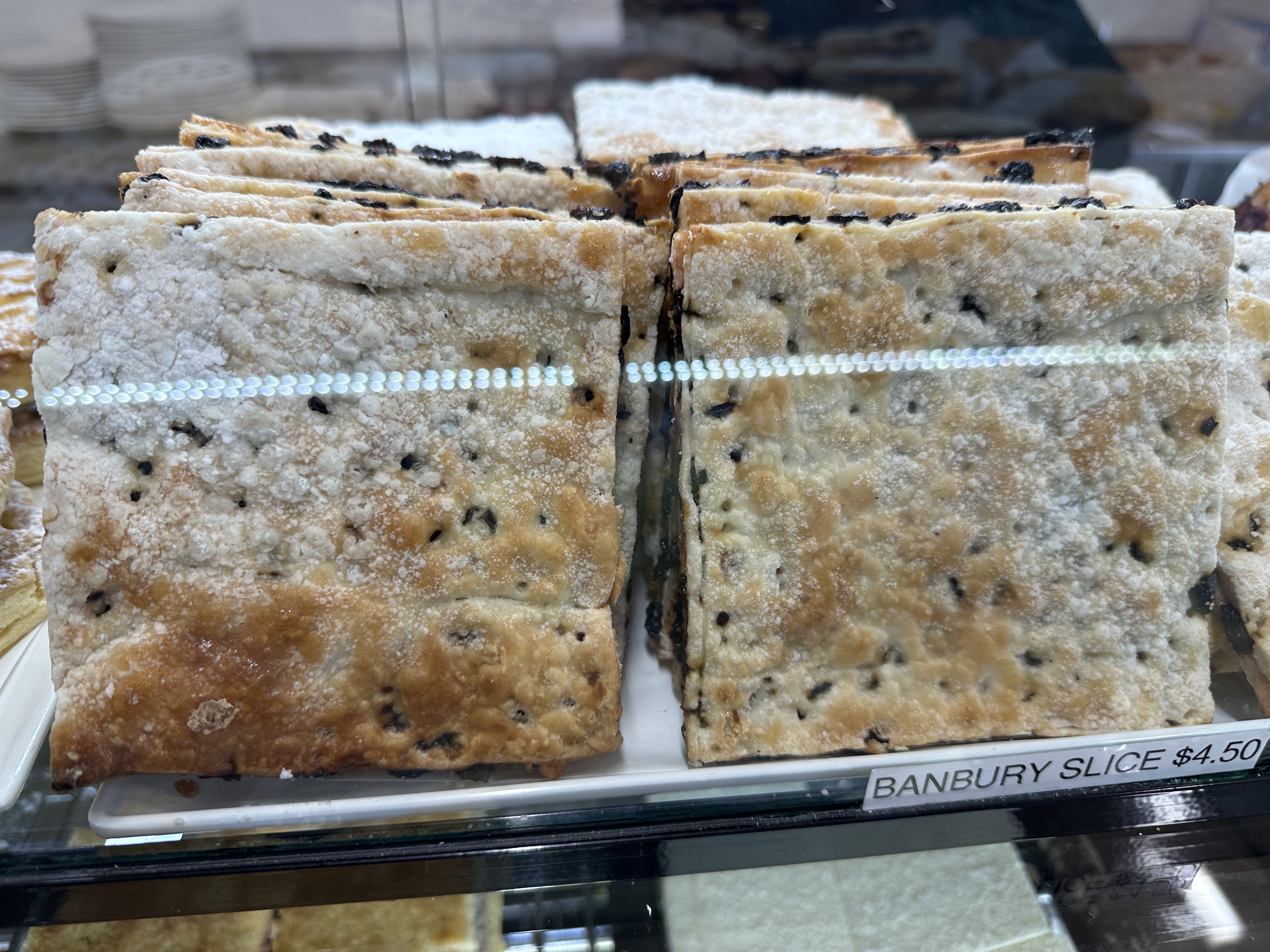
The next day we left Hobart for our upcoming night’s stay at Cradle Mountain Hotel, within the Tasmanian Wilderness World Heritage Area. Along the way we stopped at a few small towns. Our first place to stretch our legs was in the town of Ross where two of us shared a tasty, currant-filled Banbury slice. See photo below:
Banbury slice
In Campbell Town, we spent time reading bricks. Each brick listed the name of a convict, their crime and years sentenced. If a female convict was to marry, her sentence was no longer. The townspeople got the info for the bricks from the ship manifests that brought the convicts to Tasmania. These bricks line the roadway on 2 sides of the main thoroughfare.
Deloraine was our next stop for lunch and again to stretch our legs. Cute sculptures were on corners. I was also looking for a red telephone booth and this is what I found:
Need to call someone?
Any one can make a free local phone call from a red telephone booth in Tasmania. How important it is to reach out, for whatever reason, and get help when you need it … just a phone call away. Coincidentally this day was also “RUOk Week” or “are you okay week”. Our guide’s boss texted our guide to ask “are you okay” and our guide asked our driver if he was okay. Very cool!
Finally we arrived at Cradle Mountain Hotel. Just before dinner I saw my new bird for the day, a Black Currawong!
Holy mackerel it’s a long flight from Los Angeles, California, USA to Sydney, Australia, then to Hobart, Tasmania, Australia where I am starting my “down under” adventure!!!
At the Hobart, Tasmania, Australia Airport, I saw an interesting statue of the Tasmanian Devil. While helping a young student in Tucson, Arizona, USA complete her “Flat Stanley” project, I took a photo for her. She’ll research, is there really a Tasmanian Devil and locate where in the world is Tasmania, Australia. (The answer to the question is, yes the Tasmanian Devil is the largest carnivorous marsupial in the world. It once lived on mainland Australia. Now listed as endangered and only found in the wild in Tasmania.)
“Flat Stanley” with Tasmanian Devil statue at Hobart Airport, Tasmania, Australia
Arriving exhausted, I simply went to sleep once at my hotel. The next day I was up birding and exploring. (Actually I did see a masked lapwing the previous day as my driver drove me from the Hobart Airport to my hotel.) My first full day, I wandered the streets of Hobart, approximately 270,000 people, and saw 9 different birds. Stopped at the grocery store for some snacks: Lamington Fingers and TimTam were on my list. At the grocery checkout line a woman joked with me, “One must come to Australia to get the Timtam”. Her favorite snack when I asked which of the two she enjoyed most.
Lamington Fingers… soft and tasty!
TimTam… may be my favorite too!
The wind blew all day and I don’t think it hit 60 degrees Fahrenheit. I had my winter jacket on although technically it is the start of spring here. I envied the locals who were walking around in t-shirts. Rain is a sometime-thing. When I left the airport the previous day it absolutely poured for 5 minutes and that was it. Today it sprinkled for 2 minutes and that was it. Tasmania, an island of almost 500,000 people total, is subjected to whatever the winds blow on and over it. Umbrellas are everywhere. I cannot imagine holding an umbrella in these winds.
I continued my wandering of Hobart. Walked through Franklin Square, St. David’s Park, Prince’s Park, Salamanca Center, along the waterfront, stopped in at St. David’s Cathedral, ate lunch at The Whaler, and literally got blown around the town. It was all fun!
Tonight I meet my fellow travelers with Overseas Adventure Travel (OAT). We are here for six days before heading to mainland Australia. I will maintain this blog possibly with more blogs per week than my usual, so check-in often mate.
Photos from my first day wandering:
Battery Point neighborhood in Hobart
European goldfinch
St. David’s Park … where I saw 8 different bird species