Michigan Visit: Part 1

Michigan made my list as the state I would visit on my return trip to Arizona. How is it I missed this state in my past travels; not to happen now! While driving the green and rolling hills of this state, I was reminded of my geology classes about this state’s glacial history. The glaciers truly carved out a spectacular landscape! Also are historical signs and headstones dated from the 1800’s; reminders of the people who traveled via the underground railway to this state. As I looked on, I noticed the state’s apple blossoms coming; fisherman hoping to catch brook trout; white-tailed deer running across the roadway as I drove … while some did not make it; antique shops, fudge shops, wineries, asparagus and fresh fruit stands are available and for sale with cherries hopefully in July. Plenty of open spaces, marinas and parks along the lake to occasionally stop and stretch my legs and relax my eyeballs.

My original plan was to visit Detroit, Ann Arbor, Lansing and drive to the Upper Peninsula of Michigan. However ever flexible when on the road and with amazing good luck, I tracked down a college friend! I’m off to Kalamazoo! Besides seeing my friend and her husband, their home was a birder’s paradise. So many feeders to attract the wildlife in their forested backyard! Of course, reminiscing about our college days and discovering how we are each enjoying retirement was fun too. These 2 people are each creative and talented in their area of expertise, glass and wood. Beautiful, and award-winning, pieces have been made. I was thrilled to visit them and see their work as they continue to enjoy retirement.

Heading north: Through Ludington, Manistee, a stop at the largest sequoia tree outside of California, drove past the “Largest cherry tree in Michigan”, Arcadia Marsh, then Sleeping Bear Dunes National Lakeshore, with an alpaca farm Harvest Host location for my night’s stay. If you have a chance, sometime look at the shape of Michigan; a mitten up and down and another mitten side to side. I don’t know the miles of coastline, but I do know there are 129 lighthouses. I stopped at many of them! The most common comment made by locals is just how low the lake’s water happens to be. With the latest major rainstorm and damage done, the interior lakes all seemed high to me. 

116 foot tall, biggest Sequoia Outside of California

I stopped at Arcadia Marsh and walked with a woman new to birding. That was fun as we interacted with a group who were observing a short-billed dowitcher. That bird did its best to hide in and out of the cattails, but we all saw it! (I’m always appreciative of fellow birders spotting and sharing a bird’s location!) At Sleeping Bear Dunes National Lakeshore, I skipped the crowd climbing the large dune. I recalled my African Sahara dune walks where it was hard walking up a dune, but so very easy coming down! Instead, I stopped at another spot on the lakeshore to walk and circle away from a designated nesting piping plover area. Ended my day with a restful sleep at an alpaca farm after speaking with my host!

Along Sleeping Bear Lakeshore
An informative sign for a first-time visitor!

Onward. Traverse City struck me like many other places, yet I was surprised within the city limits everyone had a sidewalk! I stopped at another lighthouse: Mission Point Lighthouse and drove north to Charlevoix. While trying to locate the “mushroom houses”, I dead-ended at a great place for lunch. Near a gigantic cement place, birds congregated. I walked that lakeshore looking at mute swans and mergansers. I did eventually locate the historic district where Earl Young’s architecture is standing. In the Charlevoix area, there are 26, of the once 31, homes built by Earl Young from stones and boulders lining the shoreline of northern Michigan. Tours are provided to learn more about this man’s work, but all homes are private with no opportunity to step inside. The “mushroom house”, “Hobbit house” or “gnome house” is a term for the low ceilings, circular floor plan with rooms around a big fireplace and chimney, and curved roofs altogether resembling mushroom caps. I located 4 of the homes on my own.

Finally arrived at Mackinac (pronounced as MACK-in-awe) Island which sits in Lake Huron, another one of the Great Lakes. Taking advantage of a sunny afternoon, a fast ferry ride took me to this island where no cars are allowed. There are residents on this island, within 5 small hamlets on the island, and tons of tourists! An 8 mile road for walking or bicycling circles the island along with numerous hiking trails across the island. Horse-drawn carriages are available too. The majority of people are day visitors with the last ferry leaving at 9PM … and probably a great time to see the sun set at 9:15PM during the 16 minute ferry ride back to the mainland. There’s plenty of history on this island as people visit and learn about the 1780 Fort Mackinac, the various art museums or stay at the 1887 National Historic Landmark, the Grand Hotel. Plenty of bed and breakfasts and other lodging are available too. The easiest part of my visit: eating expensive ice cream. The most challenging: climbing the 207 steps up the Spring Trail to see Arch Rock after hiking miles to get to the trailhead!

Arch Rock on Mackinac Island

The weather remained beautiful for another “no drive” day, so out came my bicycle. I rode portions of the North Western State Trail, North Central State Trail and took a ride into downtown Mackinaw City. The two trails were gravelly for the majority of my riding time and downtown was paved roads. The town as the island welcomes tourists to spend money on all kinds of things! It was a great way to spend my day on this “lower mitten” of Michigan. Next is the Upper Peninsula of Michigan.


Rest Area Award Goes To…..

Rest areas can be wonderful places to stop and rest while traveling long miles. Of course each rest area across the country often reflects the geologic, architectural and/or geographic look of the the area. Or some are boring cell-like places with pit toilets. My wish at a minimum is that they all be clean! Beyond that, I appreciate rest areas including travel information, vending machines, pet exercise areas, picnic tables with shelter and historical information about the area. 

As a traveler, I have driven thousands of miles. The last few years it has included miles back and forth across the USA via different routes. Therefore, I decided to shout out and choose the best rest area in the USA. It is on Interstate 86 east in New York State, the Chautauqua rest area! I have no physical certificate for this pronouncement; however, I did thank the employee who was on the grounds. I think I made his day with the simple recognition of the good work all were doing at this rest area. And that he was being personally thanked.

The rest area was so nice I decided to have my breakfast there. Earlier in the morning I left my Harvest Host location, a brewery where I could not make my breakfast …. you may recall my van has no cooking, plumbing or electrical appliances. Out came my backpacker stove, etc and I enjoyed breakfast with a scenic view at this rest area. Plus the restroom was so clean!

Thank you to the employees at the Chautauqua rest area in New York State! You are chosen as my BEST REST AREA!

Breakfast at my award-winning rest stop in Chautauqua!

Remember Importance of Memorial Day

Memorial Day is the day in the USA where we remember and honor the men and women who gave their lives in service to our country. It’s a federal holiday; time to reflect on the sacrifice and courage all the individuals who served for our country had put forth. 

Sometimes I even think: do I have what it takes to serve as these individuals did if I was called to serve? And I ask myself: how do I help my community, my state, my country, the world achieve peace? 

Remembering this day, however you do, is important. It may be a tour of an old battlefield. A visit to a cemetery. Thank you statement or handshake to a Veteran. Attending a Memorial Day parade. Whatever, thank you for taking a moment to remember.

Many battlefields are across the USA & world.

Walking Quito, Ecuador

Ecuador’s geography includes a coastline, the Amazon rainforest, the highlands in the Andes Mountains and the Galápagos Islands. I flew from the USA to Quito, Ecuador, the oldest capital and declared an UNESCO Heritage site in 1978.  The city sits at the foot of Pinchincha volcano. We visited Old Town Quito. Two thousand feet higher you’ll discover the modern parts of the city. The city was originally founded in 1534.

Fresh fruits and vegetables

I am with a 12 person tour group, Overseas Adventure Travel. We visited Old Town Quito with its 60 plus Catholic Churches. The Church of the Society of Jesus required 160 years of work to complete it with all its surfaces gold-plated. Interestingly we noticed there was Virgin Mary pictured at the alter, not Jesus. The Ecuadorian people admire mother/Virgin Mary.

200 pounds of gold-plating within church bought over 160 years

Santa Clara market is in Old Town. One area with fruits and vegetables, another area with meat, and another with flowers. Ecuador has many greenhouses where 98% of the plants grown are roses. A short walk from the hotel, I stopped in at the La Mariscal Artisan Market. Each vendor has a stall displaying woven fabrics, such as alpaca blankets, and baskets, etc. for purchase.

Many greenhouses for the roses

We also visited the Inti Nan Museum and Agave Museum. Both had fascinating displays and much to learn from the presenters. At the Inti Nan Museum we stood on the equator and I balanced a raw egg on a nail. At the Agave Museum we had a tour of the gardens, a delicious lunch and tasting.

Unfortunately I made an observation in the city and our guide admitted to a huge pollution problem. When using a toilet, signs indicate no toilet paper is to be thrown in the toilet. As we traveled down the thousand feet from luxury housing to more shambled housing closer to the main river in Quito, I asked why there was so much foam on the river’s surface. I suspected the answer, but wanted to know for sure. Our guide admitted there is no sewage treatment of the city’s waste water, thus the foam. It’s a problem requiring lots of money to solve and one politicians never talk about. I understand there was a dam to generate hydroelectric power further down the river; however, sediment built up at it and only 30% electricity is generated. It doesn’t sound like a solution to waste water is coming.

Ecuador: See, Eat & Learn While Here!

My travel begins in Quito, a city in Ecuador with a population close to 3 million people. It is the oldest South American capital, UNESCO World Heritage site. Quito is the second highest capital in the world at 9,350 feet. (There is debate about it possibly being the highest … check out LaPaz and Sucre, Bolivia for details.)

After my days in Quito, we will be in the Amazon rainforest. We follow that time with close to a week to visit the Galápagos Islands, another UNESCO World Heritage site! It’s a quick trip with plenty to accomplish while I am in Ecuador.

Quito was founded in 1534. I love old architecture, plus South American cuisine, so walking the city’s plazas will be fascinating! We’ll fly, then take a motorized canoe to a village in the Amazonian rainforest. There are 40 families at this village and my chance to learn about their shift to eco-tourism. We’ll return to Quito and fly to the Galápagos Islands. There we will board a small ship for 7 nights as we tour what we can on the islands. There are 13 islands; however, all is protected … including surrounding waters. With permission from the Galápagos National Park, our visits will be allowed on certain islands. They work to maintain low impact to the land, water and animals. No doubt, many other tourists will arrive and I’ll be looking for birds and giant tortoises!

I have begun my research of interesting Ecuadorian foods for me to try. Plus, places to visit and birds to look for while in the city, rainforest and on an island or two. It was Charles Darwin, a naturalist in the 1800’s, who first proposed the scientific theory of evolution through natural selection. Now I’ll have my chance to see finches, mockingbirds, tortoises and iguanas that prompted his conclusions!

I’ll keep you posted! Adiós!

Where am I going? I’m a map person!

While Columbia is to the north and Peru to the south of Ecuador, please know there are more countries in South America! This map is just a start for all to know where Ecuador is.

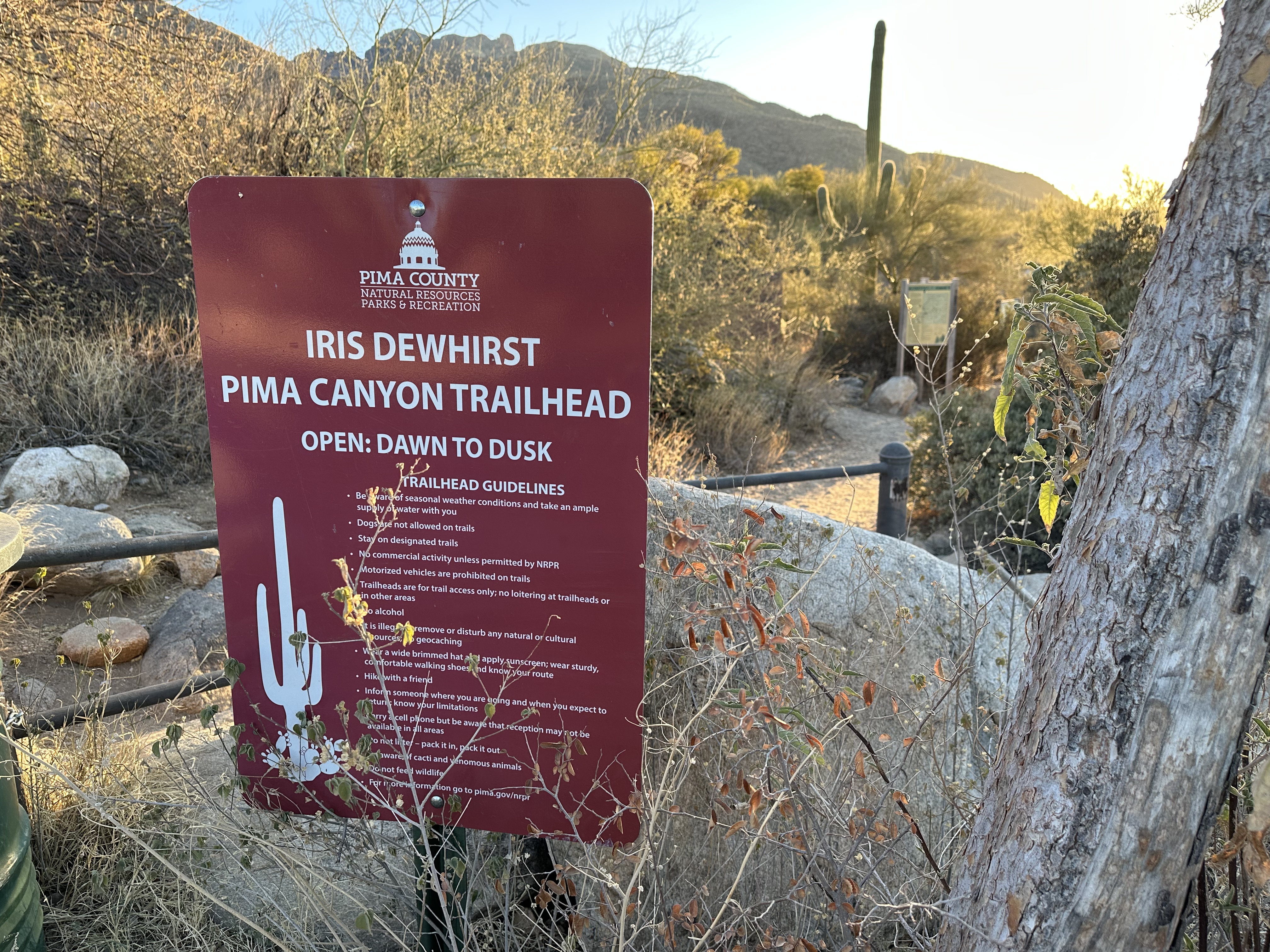
Welcome to Iris Dewhirst Pima County Trailhead

Always looking to hike in various areas around Tucson, Arizona, I decided to hike from the Iris Dewhirst Pima County Trailhead. An environmental education Pima County staff person and I met at the paved parking lot. It’s a huge lot capable of holding 45 vehicles.

No dogs allowed.

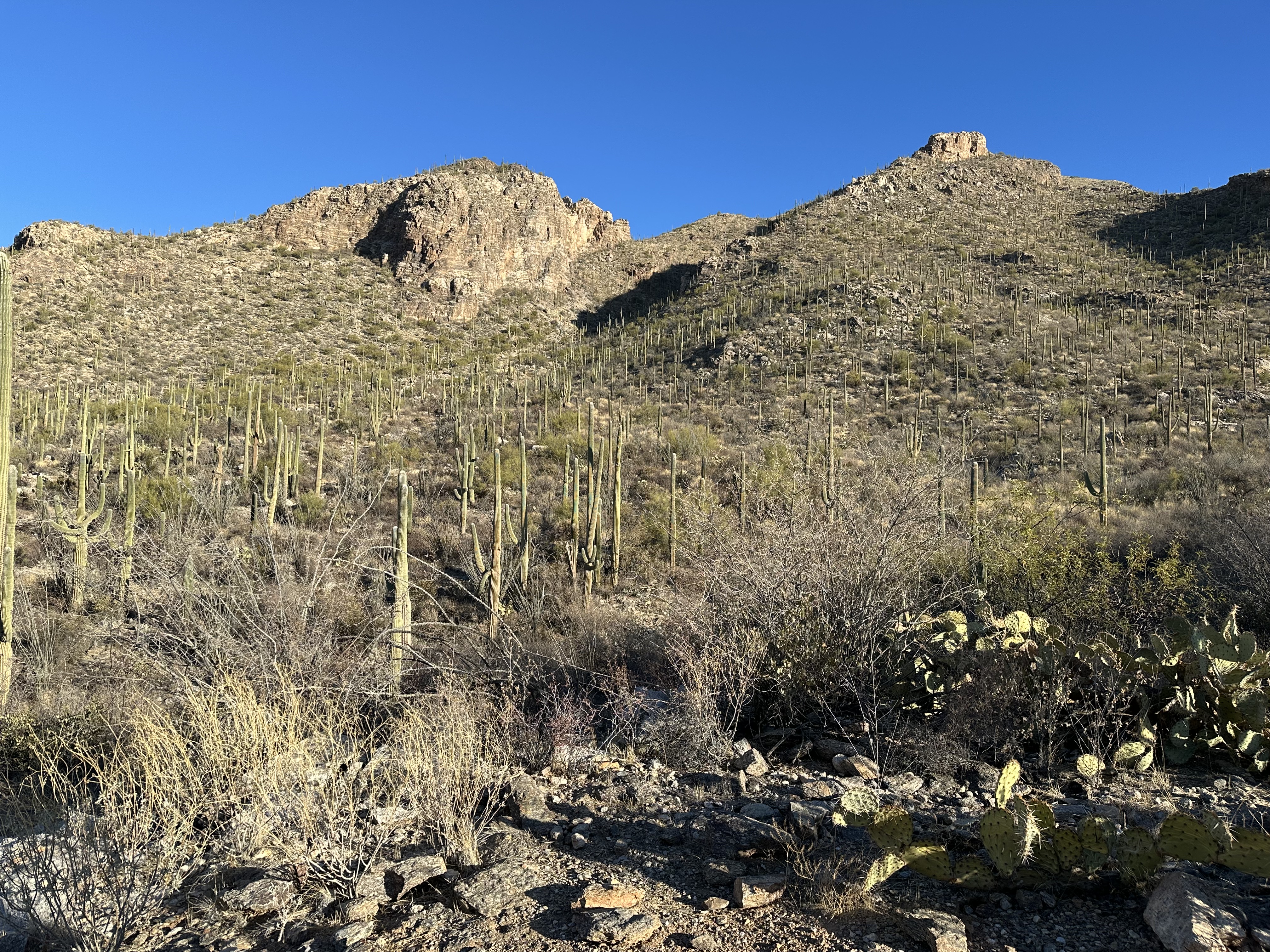
The first 1700 feet of the trail is owned by Pima County. Then we enter Coronado National Forest. It’s a rocky trail with some short climbs, but otherwise an easy trail for the first couple of miles. You’ll see other hikers and trail runners out on the trail even during mid-week. If you continue into the Pusch Ridge Wilderness it does have a substantial elevation gain, so do your research as you decide what distance you wish to hike. Also know, between January 1st to April 30th, it is prohibited to travel more than 400 feet off the Forest Service trails for bighorn sheep lambing season.

So who was Iris Dewhirst? She was on the Pima County Board of Supervisors between 1984- 1988 representing District #1. While interested in mental health issues, the YMCA, recycling and libraries, she also wanted to protect desert environs. Her goal was to have buffer zones between housing development and the natural resources, such as the national forest lands.

As you hike the trail it is very obvious that you are near backyards of many homes, but walking further into the wilderness to be away from them. Their sight and sounds soon are nowhere to be seen or heard and it was wonderful. This trailhead and trail though are the only way to access Pima Canyon! Thankfully Iris Dewhirst helped create this access.

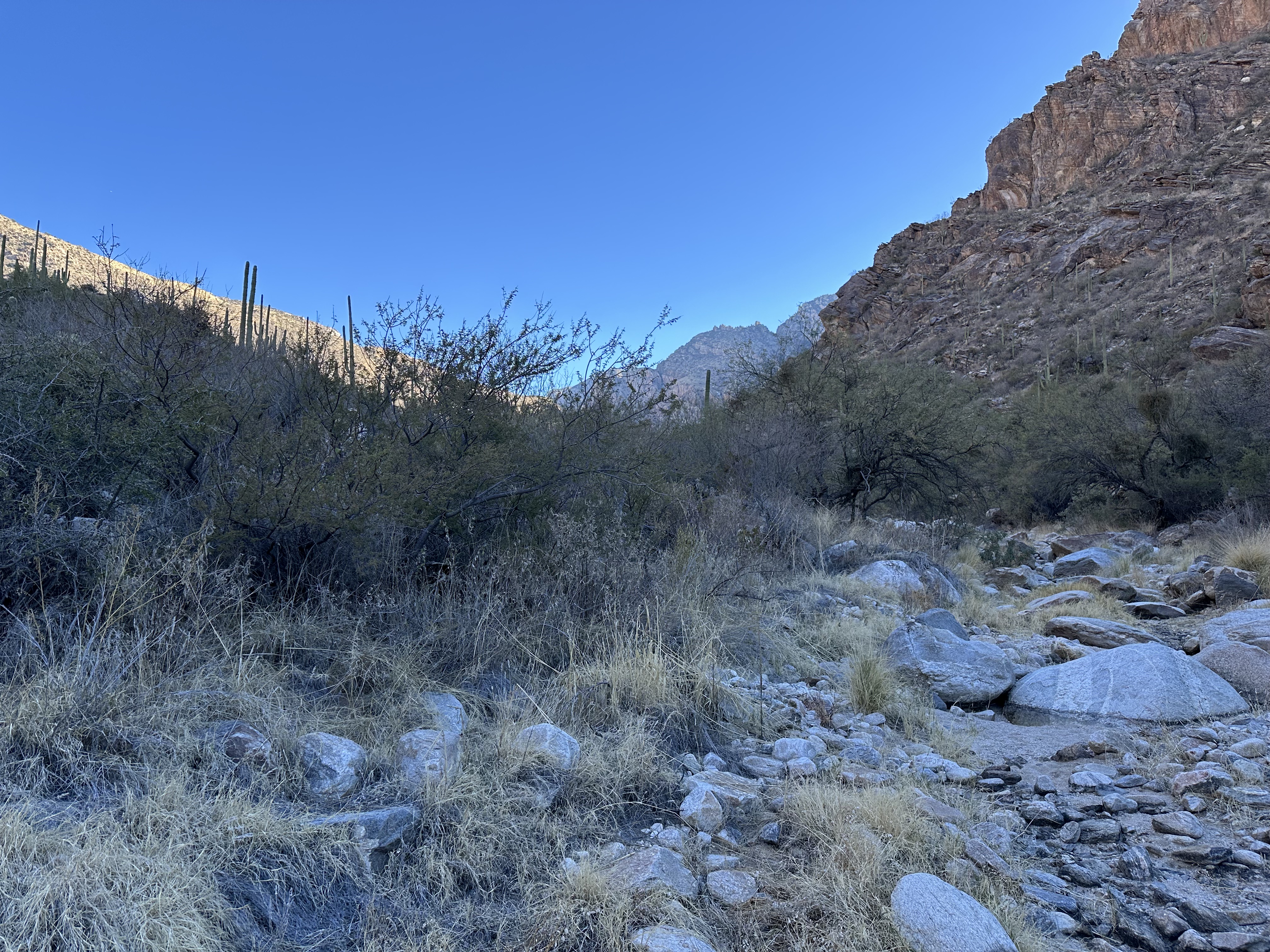
We looked for bighorn sheep; saw none. Enjoyed seeing some wildflowers and found a couple of pockets of water where cottonwood trees loved to be too.

Turpentine bush
Walking in the wash at a point

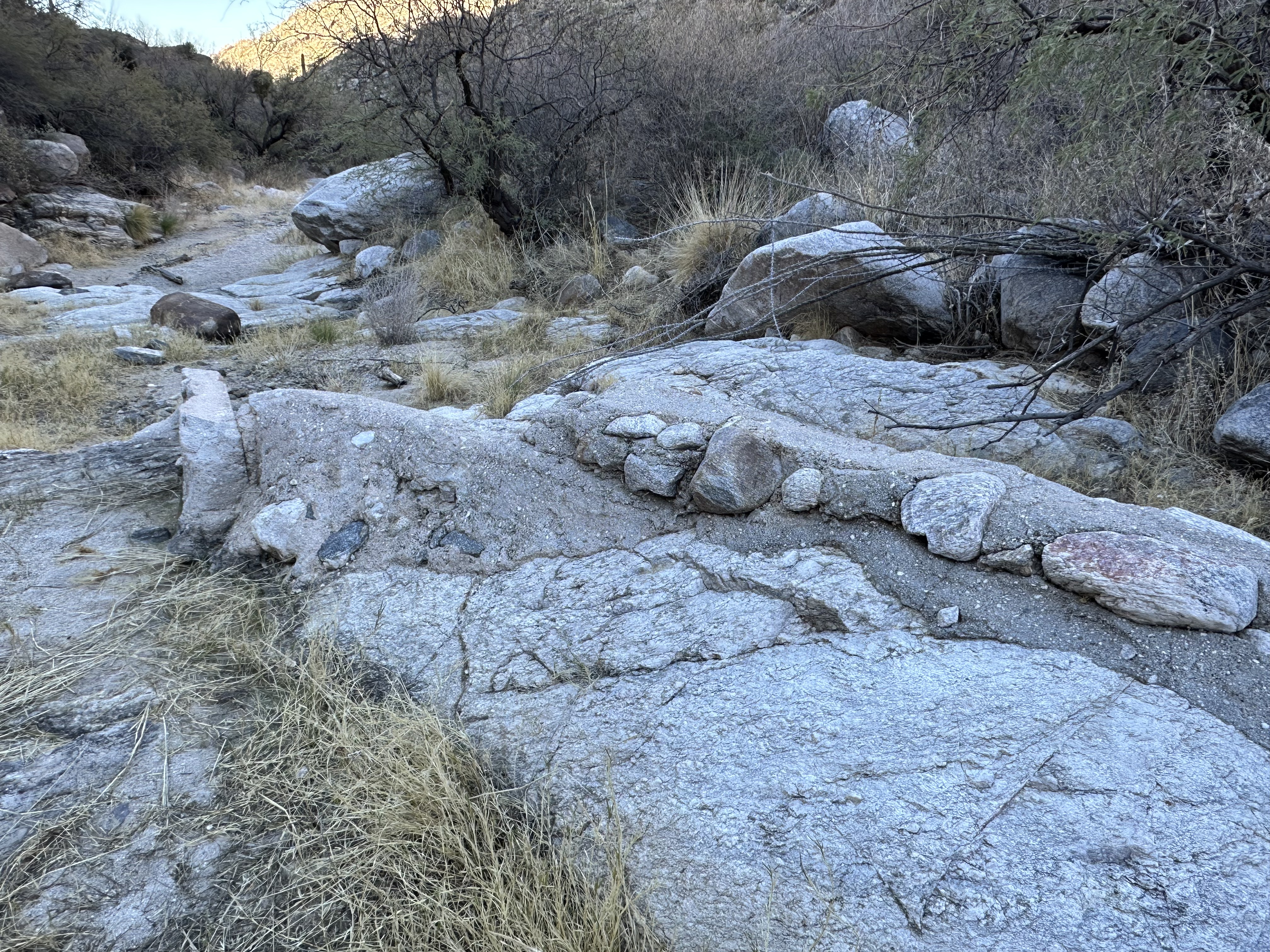
Amazingly there was a dam built many years ago. If you look closely at the next 2 photos you can see both sides of the dam.

Thanks also goes to Iris Dewhirst for creating Tortolita Mountain Park. I have to add that to my future hike list. I appreciate having individuals in the world that work to protect natural resources. Otherwise, we would have housing right up to mountain tops and wildlife would have no place to live. And our hiking areas would be gone too! Let’s protect our lands for all to use!

Fibrous Material Put To Use … From Pineapple?

Using natural fibrous material to weave into footwear or clothing is not new; think agave leaves used hundreds of years ago for such needs. However, using the fibrous waste product of pineapple leaves is a new use. There are 20 – 30 leaves per plant now being put to use, from what I recently learned.

Within the Earthshot Report of 2024 was mention of Dr. Carmen Hijosa. This Spanish entrepreneur developed a material to be used as an alternative to leather. Time in the Philippines in the 1990’s was where she saw the abundance of pineapple leaves. She worked to create a textile using that waste product. Many years later she has a company, Ananas Anam. I like their website quote from Dr. Hijosa: “Design is not just about the product. Design is about responsibility.” Pineapple leaves are being used, many local people are employed and there is less waste product as an alternative material is made.

Check out Piñayarn and Piñatex fabric at the Ananas Anas website. While I was thinking to find various fabrics, I was pleasantly surprised to see some BOSS sneakers made with Piñatex.

Protecting Mother Earth; the Rights of Nature

Mother Earth is referred to as “Pachamama” by indigenous people. In 2008, the Ecuadorian Constitution recognized “ … the rights of Pachamama to maintain and generate its cycles, structure, functions and evolutionary processes”. Here was the “rights of nature” written into a constitution! Wow!

As a result of the Rights of Nature Movement, Ecuador has 9 nine national parks, including the Galapagos Islands. The goal of the movement is to recognize and protect ecosystems: rivers, forests, and to restore the connection between humanity and the environment. Ecuador has 25,000 plant species and 1600 known bird species.

I was fascinated learning about Mother Nature having the same rights as people while watching an Earthshot presentation on television. Spain, New Zealand and some USA local governments are also interested in reducing deforestation, protecting ecosystems, and have versions of that goal in their laws. More awareness is needed. If not for the “Rights of Nature” concept, then at least a realization this planet is our Mother Earth. We have no other place to go, in the foreseeable future, to escape our destruction of the land, air and water we need to survive. 

Indigenous people have tried to protect their lands for centuries. They are our neighbors throughout the world. We might wish to protect the living world as they do too … with the belief animals and plants are equal to themself with the same rights as human rights.

I know some people reading this will probably wonder, what the heck!?! Same rights as humans? If you think about a plant and/or animal you eat, let’s say for discussion, corn and/or chicken. Do you not want to provide healthy soil/land, clean air and water for the corn and chicken to grow? They are the same rights you want for yourself … unpolluted land, clean air and clean water. Plus you’ll soon be eating that corn and/or chicken in some format of food.

It would be a gold standard if countries had it in their constitution; any actions to follow the “rights of nature” concept. In reality though, we each could speak up. Let’s require corporations, governmental agencies, businesses and each other to put our best effort into protecting Mother Earth. Younger generations wonder if we care about ourselves right now … yes, awareness is here, but actions need to be taken! We have one Earth … and we are here to care for all land, air and water now.

Palms: Fan versus Date

So I mentioned I would write a blog about fan and date palms … and here it is! 

First off, palms are not trees!! Now I found that interesting because I always referred to them as a palm tree. Yet technically, palms are grass that have leaves growing from the trunk and lack bark. They are considered also as large, woody herbs. Lots of science available to read all about it, if you wish, just not here!

My interest in palms happened when in California last month. All of a sudden I realized there was a difference in the palms I was looking at. As I drove around parks and golf courses, I did not take notice. Often I was looking at date palms. I buy my dates at Shields Date Garden in Indio, California, no wonder I saw them most often! Yum!

By the way, date palms were brought to California by Spanish missionaries in the 18th century. Here is a date palm with its feather-shaped fronds and its unpicked, dried out dates:

Date palm

Then we were at Anza- Borrego Desert State Park. I learned there is only one palm native to the state of California, and it is not the date palm. California’s Washingoni filifera is the native palm. It can grow to 65 feet tall, with fan-shaped leaves and small, black fruit. Once you observe palm leaves closely, you’ll notice a fan palm has fronds from the top forming a crown. Each frond actually looks like a fan. 

The native California fan palm has been around since forever, whereas a similar looking Mexican fan palm is considered invasive. You will see the Mexican fan palm all around southern CA and Los Angeles! And you’ll notice, I did not get a photo of a California fan palm.

Here is an invasive Mexican fan palm, notice the fan-shape:

Mexican Fan Palm

Take notice of the next palm you see … one does learn something new every day!

Your Right to Celebrate

During the upcoming week, many of us will participate in personal celebrations … some religious, some not. Humankind needs to respect each other’s differences … it is what makes each of us special. 

Some people will celebrate religious holidays, such as Christmas and Hanukkah; others will celebrate a cultural, non-religious holiday, such as Kwanzaa.

Whatever you celebrate and when you celebrate, I wish you joy!

from USA’s Southwest