Bicycling is great fun … and more so when I notice new things while trying to get those cycling miles done. Recently I learned not to look too high in the sky at flying birds while I’m bicycling … were there 2 red-tailed hawks flying up there? Geez, and need to keep my eyes on the road!
So I have been thrilled with wildlife sightings at eye level or below. I’ve seen lizards run across the road and make it successfully … and others not so successful. Coyotes often walk across the road from their usual trails. Wished I had my camera available when a bobcat walked across the road! It casually looked at me and moved on. The most fun sighting was watching a mother quail step onto the road, then turn back and indicate something to her chicks, and they all followed her as she crossed the road. Wow!
What will I see when weather warms?
What wildlife have you observed on your bicycle rides? I know some of you are under snow at the moment, but share what you have seen even in the past! You’ll be on your bicycle again in a few months!
I know a few songbirds. A verdin’s call, its bright yellow head, chestnut-colored shoulder patch and spherical nest with an entry point near the bottom are the features helping me to identify this bird. It often flies around quickly and I see it many times upside-down as it eats insects and seeds.
Recently I was at Tucson’s El Rio Preserve. I saw what looked like a nest and thought I heard a verdin call. Hoping I was correct, I knew with some patience I would eventually locate the bird.
As you can see in the photo below, the nest was well hidden in the sweet acacia shrub.
Nest right there!
I moved a distance away from the nest and waited. Another birder happened to walk by and wondered what I was waiting for. As we talked the bird flew to the nest and darted inside. I caught a photo while it sat on the branch before leaving the nest.
Verdin about to leave the nest.
Of course, I had to try my sketching and watercolor painting ability with this little bird… why not ? … here it is:
I love this frog! Will I kiss the frog, no … but it got me thinking ….
An American bullfrog
Here’s this frog in the middle of a parking lot. A distance from where I believe it should be! I would love to know where it is going. I will never know. Unfortunately I left the frog for a couple of minutes … plenty of time, obviously, for it to go its own way. Darn! I even looked for it. No success!
I love healthy wildlife. Wildlife is to be wild. This means the animal survives on its own without mankind sheltering or feeding it. Healthy wildlife will move and take care, ignoring mankind … and we get to enjoy wildlife at a distance. Those constructed wildlife bridges have been very helpful for wildlife to get across roads, for example.
I do feed birds at my feeders. Seed is out during the winter and when the birds migrate. Both are times when the birds can use the extra nutrition. Just as important is when people turn off their outdoor lights during bird migration time. I love seeing humans take action and care about a life, even a bird’s life!
I love humankind when kindness is actually in action. I believe people who care for wildlife care for humans too. Humans are not wild animals. They need shelter and food. With kindness we can help those in need. There are local agencies available to help those in need.Let’s be sure people who are in need do know what help is available. Sometimes it simply a kind, helping hand or providing guidance to an available agency. Services are available for veterans, youth, homeless and many needs … let’s connect people with what they need, just as we do when protecting wildlife!
There were two roadrunners running across my trail, but one seemed to have taken off and the other stayed with me. For a split second ….
Here one second, gone the next …
Actually it came running towards me! What!?!
Roadrunner running towards me…
I thought it strange for it to be heading right at me … then past me. My finger clicked away on my camera to capture the action. A 100-400 mm camera lens though was a disadvantage with this close-encounter.
Bird on a mission!
The Pima tribe believe it is a sign of good luck to see a roadrunner. Good to know. I always want to see the bird’s X-shaped footprints. But once again the ground did not capture the foot’s imprint. Pueblo tribes consider the footprint sacred symbols. The X-shape footprint hides the direction the bird is moving and thus confuses evil spirits. The next second I knew where this bird was heading …
into the tree….
The bird flew into a nearby tree. Rarely do I see Greater roadrunners, their official name, in a tree. So I decided to spend some time with the bird. It was making a sound similar to drumming on wood. I thought it was pecking into the tree, but it was not. All sound was coming from its vocal cords.
Bird is not making this photo easy.
The bird climbed higher into the tree. Photographing it was a challenge so I slowly walked around the tree. My goal was to capture a photo of the bird with less tree branches in the way. Slowly I stepped and clicked away, until I finally had some decent photos.
Thank you for the pose!
Jumps around for a different pose, thank you!
With tail and head almost parallel to the ground, the roadrunner was out of the tree and running to an open area. I am not sure if it caught up with the other roadrunner it was with earlier. They are usually solitary birds, but who knows?
And it is off to somewhere…
In our backyard, a roadrunner can often be seen running through. Our hope is it enjoys eating lizards and snakes it may find there. While doing some research for this post, I learned a baby roadrunner is an “alleywalker”. A flock of roadrunners, a “marathon” or “race”. Very interesting!
I’m having difficulty deciding where I want to put my art energies. Should I spend more time sketching and using an ink pen? Or should I watercolor paint with an aqua brush or regular paint brushes?
Most days I take a walk outdoors. On this day I noticed a horse being readied by a man for a trail ride. There is not usually a horse in our neighborhood, so I took a photo of it. I continued my walk and passed a sculpture of a horse. That set my decision to sketch and paint horses today!And so I did, as you will soon see.
I also decided my real art interest is simply taking on a challenge … on this day horses. I tell myself also: with each sketch I learn something new … and that’s a good thing! Some of my best work is yet to come? Maybe so, but only if I keep at it all!
Ready for a trail ride.
Walk past this sculpture often; time to sketch and paint it!
Arizona weather, especially in southern Arizona, does not provide many clues to what season we are in. Happily though we planted some pistache trees on our property. At times, these trees can provide some colorful leaves. Its deciduous leaves turn beautiful red and orange colors.
Colorful leaves!
Being from northeastern USA though, I equate colorful tree leaves with the fall season. When living there, quite often we would take a road trip to visit areas with beautiful fall colors! Yet here I am in Arizona, in January and February, with these colorful tree leaves! The calendar indicates winter … we are currently after December 21. The weather though, and reality here … I’m enjoying fall! I don’t care what month it is; hope you enjoy the colors too!
Fall in January and February in southern Arizona, according to our leaves!
Travel involves so much energy that at the end of the day I never seem to accomplish all I wish. Sketching happened to be one of the activities not done while on the road during this last trip. However, after each trip or major event, I like to sketch in my “events book”. So I did that for this trip. Plus I loved the look of the “boina” or “Gaucho hat” on the guys; I’ll sketch them too! At Rapa Nui, we had our trip guide and a local guide, so they are included in my sketch book too. Not the best sketches, but a way to keep memories and a final look at my Argentina and Chile trip. Now to travel on in 2026!
It is wonderful to see different scenery and eat new foods, but another fun aspect of travel is to meet people while on the road. People, and the opportunity to interact with people, add a dimension to the travel experience no photo or travel book can provide.
Let’s me start with my fellow travelers. They come from different USA states, with varying personalities and travel experiences. This allows me to enjoy understanding their perspective as we all look at new experiences while traveling together. It’s enlightening and I appreciate the daily interaction. What’s best too is the fact we have each other’s back while traveling; keep each other on-time, safe, aware of details and learning new things. I must admit I was pleasantly surprised when some of my fellow travelers joined in looking for birds while on a hike! It is always great to have more eyes on the scene. Maybe they enjoyed the opportunity to learn about some new birds too? Hope so!
Then there are the people I just happen to meet. Tables in South America are closer in hotels and restaurants than one would find in the USA. As a result, I met an older man at breakfast one morning … actually it was a couple of mornings since I arrived early to my tour. This 83 year old man from New York City was reading Agatha Christie. Somehow we started to talk and I learn he was to meet his friend for travel in Chile, yet his friend died a few days ago. The friend was almost 20 years younger than him. So now this man was here to attend a funeral.
I am a good listener and I think it is why we talked again the next morning at breakfast. Yet I learned much from him. He had traveled for a month in Japan visiting 9 cities recently and hired Uber drivers per city. I walked away from the conversation realizing 83 years old is still young! Wow! (And then my fellow travelers show up and there are three 80 plus year old people!)
Someday I hope to get my touring bicycle out and ride again, whether across a state or country, whatever. So whenever I see touring bicyclists I am always drawn to find out about their adventure. Here I was on Chiloé Island, Chile talking with bicyclists from Belgium! They were bicycling 5 weeks in Chile, their last week on Chiloé Island and having a wonderful time. Amazing!
Bicyclists from Belgium; one fully loaded bicycle!
Many people make a tour interesting. We had a couple of home-hosted meals and spent time with a family for a day so we could talk with local people. Whether it’s the couple explaining how to tango and showing us their professional dancing ability, or an indigenous person talking about their culture and goals to protect their sovereignty, or an employee demonstrating how to make a Pisco sour … they all add to my travel experience. Plus with the help of our trip guide, when necessary to translate another, we have an opportunity to learn quite a lot. In many locations we also had local guides, so plenty to ask of them!
Demonstration on how to make a Pisco sour.
Mapuche tribe member and our guide translating for him.
And then sometimes you see something you have never seen before. So I include this; as we are carted off to a boat for observation of penguins, etc at Puñihuil Wildlife Reserve. (It is the only place where Magellanic and Humboldt penguins nest near each other.) Anyway, it was fascinating how half of our group stood on a platform that was rolled out to the boat. We could then board the boat and not get our feet wet! These employees are rolling people out to a boat, and back from the boat, numerous times in a day. Fascinating! Never saw this before and appreciated having dry feet.
Rest of group rolling toward the boat.
Now boarding the boat with dry feet!
Sure there were beautiful scenes, but it was about sharing them with others as we stood together looking at it. There were also individual moments when a conversation started with someone I never knew. It’s a joy to interact with people; it adds to my travel experience and I am always grateful!
I am amazed for a trip, not being a birding trip, I saw 61 different species of birds while visiting Argentina! No surprise then for 37 bird species to be new ones for my life list of birds! Yes!
Here are some of the birds I saw. The Patagonian mockingbird reminded me of mockingbirds at my home. They are constantly calling and changing their calls.
Patagonian mockingbird
An easy gull to identify:
Brown-hooded gull
Shovelers have a distinct bill. I just needed to learn the one I saw is a red shoveler:
Red shoveler
Arriving at a lagoon, I saw this swan and immediately knew it was a new species for me!
Coscoroba swan, the smallest of swan species
I loved looking at this bird’s eye:
Spectacled tyrant
This bird I almost didn’t capture with my camera and knew it would be a new species for me:
Look closely in center for tufted tit-tyrant
I’ve seen ibises, but here was a black-faced ibis:
Black-faced ibis
There were many other birds I photographed; however, I would have loved my larger zoom lens to truly have better photos. Yet, it was not birding trip so I think my smaller zoom did okay! A great trip with my fellow travelers sharing in the joy of seeing birds as we learned about each country we visited. What fun each day! If you missed the birds I saw in Chile, then click here.
This was not a birding trip. I purposely chose an adventure where I could learn about the Chilean culture, eat the food, interact with local people and learn the history of the country. Yet, I did observe 55 different bird species while in Chile; 36 of them new to me! So here are a few I saw.
I know house sparrows can be found throughout the world; however, I saw this very cute sparrow and wondered what it was. A rufous-collared sparrow … a bird I will see often.
Rufous-collared sparrow
There are some birds you have an idea of what they may be because of their sounds/calls. These two I knew immediately: Chilean mockingbird and monk parakeet.
Chilean mockingbird
Monk parakeet
One day I took a walk to a park, not really expecting to see anything new. Along a grassy edge of a pond I saw this bird and guessed it to be a rail. Yes it was! A plumbeous rail:
Plumbeous rail
While on Rapa Nui, Easter Island, there was a bird I wanted to keep my eyes open for before I left the islands. I mentioned it to a park guide and our local guide. Both said it is a difficult bird to see. However with more eyes searching, a day later a fellow traveler pointed to a bird and the guides confirmed its identification.A fellow traveler, Charlie, captured this photo of the bird for me. It is a Chilean tinamou.
Chilean tinamou, photo courtesy of Charlie G.
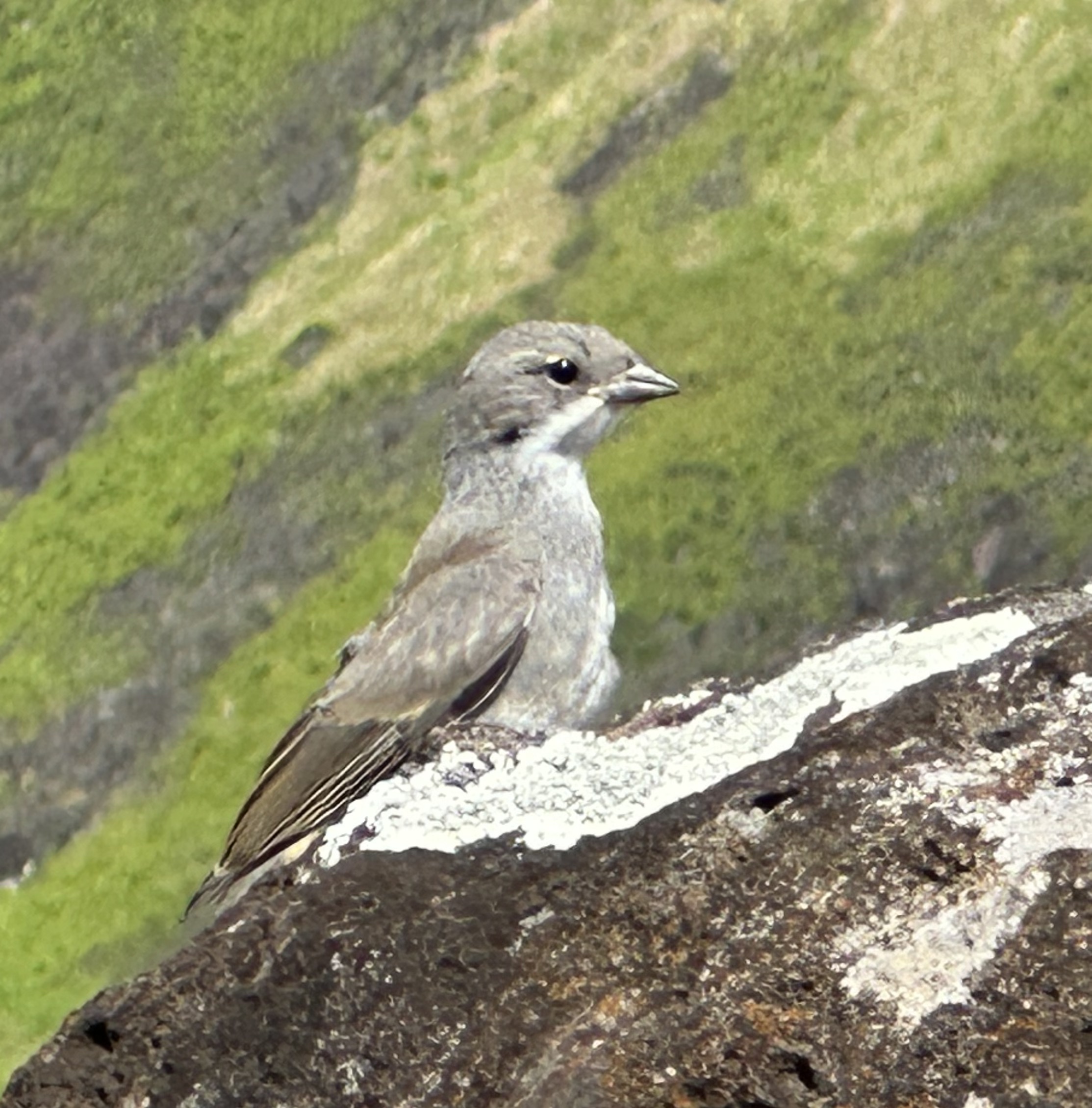
We have caracaras and finches flying around in southwest USA; however, here was a Chimango caracara and a diuca finch. I’ll see them often.
Chimango caracara
Diurca finch
We hopped a raft and saw birds on a rocky island offshore from the Chilean coast. My first time seeing a flightless steamer duck, 2 more types of penguins, and a kelp goose.
Flightless steamer duck
Humboldt penguins
MagellanicPenguin
Kelp goose
I already knew of 2 types of cormorants and now I was to learn of 2 more … Guanay cormorant and a red-legged cormorant.
Guanay cormorant
Red-legged cormorant
It’s interesting when you get other people noticing birds and they are sharing their observations with you. Many times it happened; however, two in particular stick out for me. A fellow traveler was eating breakfast and noticed a bird out the window. She shares the information with me so I went to look at the bird. Realizing I had never seen this bird before, I took a quick photo and we used Merlin Bird ID app to identify it as a rufous-tailed plant cutter:
Rufous-tailed plantcutter
My trip guide knew I was a birder. He would often ask about a bird as he learned with some of my identifications. One morning I got a text about his observation of a woodpecker. Off I went and found the bird in a slightly different location. This beautiful Magellanic woodpecker was an arm’s length away from me when I crept up to get this photo:
Magellanic woodpecker
Amazing bird sightings for a trip that was not a birding trip! I loved Chile. The pace of life was calming, especially on Rapa Nui and Chiloé Island. I loved the fact drivers of vehicles would stop whenever one stepped onto the road. At times they even flashed their lights ahead of the fact so you knew they were stopping. The fish and wine were delicious, even the Pisco sour! Of course the mountains in Torres del Paine were wonderful to see and I wished we could have even done more hiking … yet without a 40 plus mph wind, if that was possible. Maybe not, as it is Patagonia! Visit Chile if you ever get an opportunity!