Birds Observed in Chile in 2025

This was not a birding trip. I purposely chose an adventure where I could learn about the Chilean culture, eat the food, interact with local people and learn the history of the country. Yet, I did observe 55 different bird species while in Chile; 36 of them new to me! So here are a few I saw.

I know house sparrows can be found throughout the world; however, I saw this very cute sparrow and wondered what it was. A rufous-collared sparrow … a bird I will see often.

Rufous-collared sparrow

There are some birds you have an idea of what they may be because of their sounds/calls. These two I knew immediately: Chilean mockingbird and monk parakeet.

Chilean mockingbird
Monk parakeet

One day I took a walk to a park, not really expecting to see anything new. Along a grassy edge of a pond I saw this bird and guessed it to be a rail. Yes it was! A plumbeous rail:

Plumbeous rail

While on Rapa Nui, Easter Island, there was a bird I wanted to keep my eyes open for before I left the islands. I mentioned it to a park guide and our local guide. Both said it is a difficult bird to see. However with more eyes searching, a day later a fellow traveler pointed to a bird and the guides confirmed its identification.A fellow traveler, Charlie, captured this photo of the bird for me. It is a Chilean tinamou. 

Chilean tinamou, photo courtesy of Charlie G.

We have caracaras and finches flying around in southwest USA; however, here was a Chimango caracara and a diuca finch. I’ll see them often.

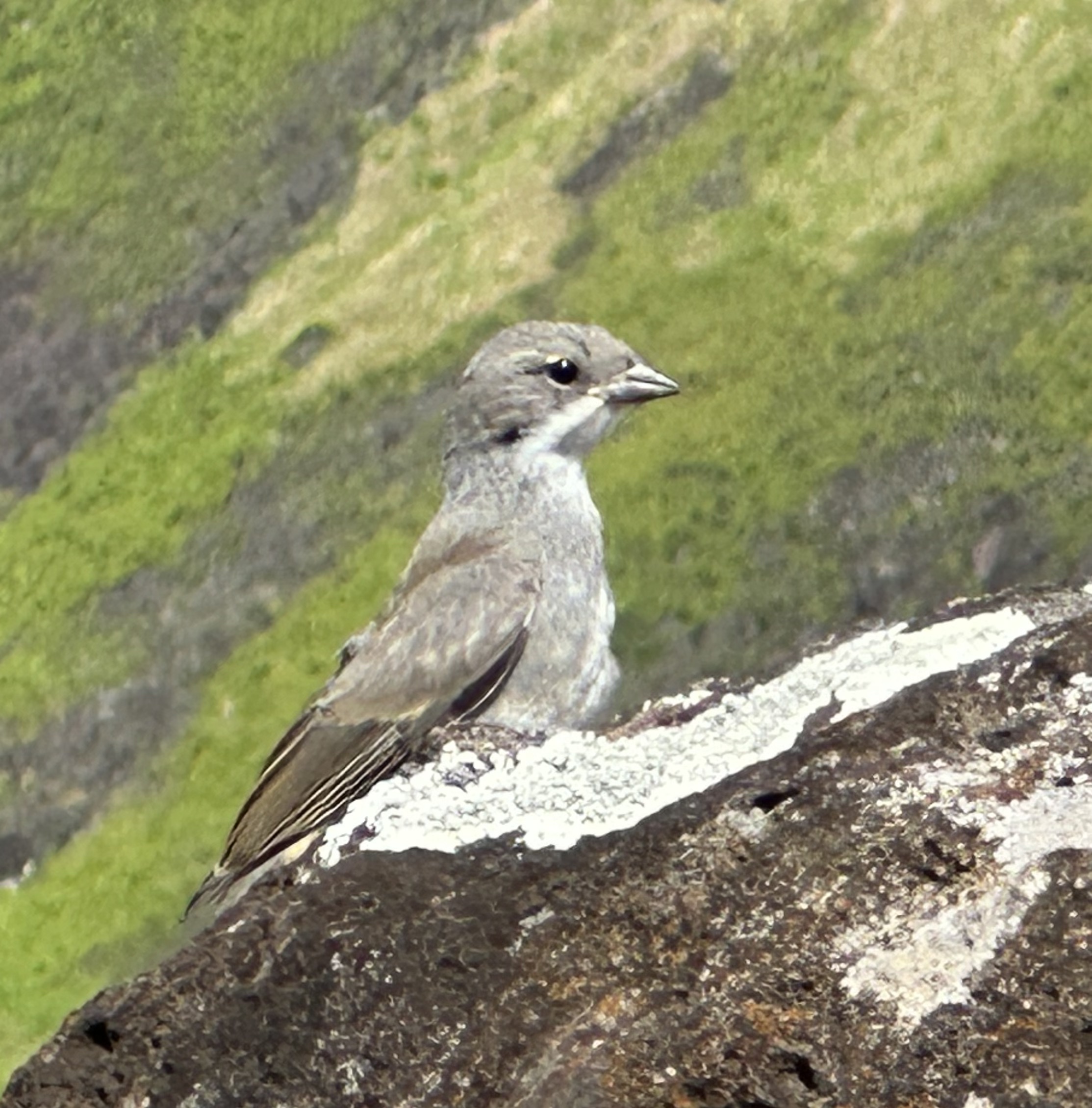
Chimango caracara
Diurca finch

We hopped a raft and saw birds on a rocky island offshore from the Chilean coast. My first time seeing a flightless steamer duck, 2 more types of penguins, and a kelp goose.

Flightless steamer duck
Humboldt penguins
MagellanicPenguin
Kelp goose

I already knew of 2 types of cormorants and now I was to learn of 2 more … Guanay cormorant and a red-legged cormorant.

Guanay cormorant
Red-legged cormorant

It’s interesting when you get other people noticing birds and they are sharing their observations with you. Many times it happened; however, two in particular stick out for me. A fellow traveler was eating breakfast and noticed a bird out the window. She shares the information with me so I went to look at the bird. Realizing I had never seen this bird before, I took a quick photo and we used Merlin Bird ID app to identify it as a rufous-tailed plant cutter:

Rufous-tailed plantcutter

My trip guide knew I was a birder. He would often ask about a bird as he learned with some of my identifications. One morning I got a text about his observation of a woodpecker. Off I went and found the bird in a slightly different location. This beautiful Magellanic woodpecker was an arm’s length away from me when I crept up to get this photo:

Magellanic woodpecker

Amazing bird sightings for a trip that was not a birding trip! I loved Chile. The pace of life was calming, especially on Rapa Nui and Chiloé Island. I loved the fact drivers of vehicles would stop whenever one stepped onto the road. At times they even flashed their lights ahead of the fact so you knew they were stopping. The fish and wine were delicious, even the Pisco sour! Of course the mountains in Torres del Paine were wonderful to see and I wished we could have even done more hiking … yet without a 40 plus mph wind, if that was possible. Maybe not, as it is Patagonia! Visit Chile if you ever get an opportunity!

Returning to El Calafate, Argentina 12 Years Later, Part 1 of 2

We left Torres del Paine National Park, Chile to drive to El Calafate, Argentina, but first I must share a photo of the view we saw when leaving the park!

Waving goodbye to park and rainbow!

It was a beautiful end to our park visit! We had quick border crossings at Chile and then Argentina and arrived along the bank of Argentina Lake at the town of Calafate. So, 12 years ago there was a population of about 5 thousand people. Now, 30 thousand! The town thrives on tourism! It looked so different to me since my last visit!

Our group visited a local estancia/Patagonian ranch to learn about the gaucho lifestyle. Our host talked of his family’s history on this ranch where he grew up, demonstrated the sheep herding routine with his dog and hand-shearing of sheep. While this happened, the BBQ fire was cooking the lamb we would eat a couple of hours later. 

As he talked, he drank mate, from a gourd with a filtered, metal straw. Mate contains antioxidants and is a social ritual in this country.
Lamb BBQ cooking
Lamb with vegetables served at our lunch at the ranch.
We learned and tried to throw the bola. It is a weapon to entangle the legs of the animal you need to get. Quite a challenge throwing the bola with any accuracy and distance.
At the ranch sheep area.

Back at Calafate, a couple of my fellow travelers joined me on a birding hike. The wind was constantly blowing so it was impossible to use Merlin ID for sound recordings. Fortunately I had my camera to photograph many. Of the 22 birds species we saw at Laguna Nimez Reserve, 11 were new birds for my life list. I’ll have a blog posts simply on birds another time.

Entrance to trail. A NGO has helped protect this lake frontage from wild dogs for the last 12 years. As we looked beyond the fencing, 2 dogs were wanting to get at the birds within.
Important protecting this area for birds!

Torres del Paine National Park, Chile!!!

The mountain-lover in me was thrilled to see these mountains Torres del Paine National Park with its 3 granite peaks, “blue towers”, was fantastic! So many travelers do not see the towers because clouds stop their view. All of our days at the national parks we skirted away from rain and were so fortunate. The wind however was another story!

Torres del Paine National Park

I remember Patagonia with wind. While hiking on 3 different trails, we experienced many levels of wind in our face and at our back, pushing us every which way at times. One day we had a hike and it was beautiful scenery with wind. The next day we had a hike to Salto Grande, a glacier-blue green waterfall, and we had less wind, but still wind.

Another hike we saw Grey Glacier and the wind was a monster!! We hiked down to the beach, yes with wind. Hiked across the beach with wind at our back and pushing me sideways at times. A fellow traveler grabbed me at one moment while I was going sideways. We then hiked a rocky trail to its end. Now to hike back, the beach part was the worst! Forty-one mph winds slamming our body! Even when without those gusts, the wind was constant and at us. My body was warm and air temperature was okay, but the wind made it cooler. It was then I doubled up on my hat as the wind made the air colder on my head. My mountain windbreaker jacket was perfect and we got nice, varied views of the glacier. Between the 2 days with 3 hikes, I think we did about 12 miles total. As I sit and write this, the wind is still blowing and I think it gets stronger as the day goes on.

Grey Glacier in the distance. Guide measured 41 mph wind speed.

Torres del Paine National Park was established in 1959 and is an UNESCO Biosphere Reserve. We did see guanacos and on our way to the park we saw Andean condors. We stayed at Grey Hotel which has comfortable rooms, nice dining area, bar and small gift shop. WiFi is at the reception area and not consistent in rooms. But rooms do have nice hot showers!

There are hikes and the “W” and “O” were most talked about as they are multi-day hikes to huts or tenting along the way. The “O” circuit was the trail where people lost their lives. They were in backcountry and were hit with sudden snow storm and winds at 70mph at least from what I understand. It was hard enough on a good weather day for me to maneuver in 40 mph wind. I cannot imagine how disorienting it would be with higher winds and snow!

I saw a beautiful bird here. It was within an arm’s length of me.

Magellanic woodpecker

I am so happy to have finally visited this national park. We had flown from Puerto Varas to Punta Arenas and drove hours to get here, but worth it! Why have I not thought ahead and continued this trip to Antarctica? I guess it will be Mendoza, Argentina, Atacama Desert in Chile and onto Antarctica the next time I head to South America. Although a fellow traveler told be of a place to visit in Bolivia … wow! So many places to experience and people to interact with as I learn about their culture. 

Next we drive from Chile to Argentina across the Patagonian steppe. I am visiting El Calafate, Argentina again. I wonder how it has changed since I was last there in 2013? Will write again in a couple of days.

I love mountains!

Update: I just heard 2 of three trails our group hiked have been closed by the national park because winds are over 60 mph. We truly are weather-fortunate!!

Chile’s Chiloé Island, Here I Come! Part 1 of 2

After an hour’s drive from Puerto Varas, we took a ferry to Chiloé Island. It actually is an archipelago of 40 islands many miles south on the west coast of Chile. We headed to Castro, the major town in the middle of the 19 mile long island. The controversial bridge being built, since the 1970’s, is still not completely built. Locals seem to not want the bridge as they fear it will change the island vibe.

Everything operates on “island time” here, meaning nothing is rushed. Whether waiting for service or talking with a local, all will be accomplished eventually. It was a change of pace I enjoyed.

It was great seeing birds at Puñihuil Wildlife Reserve. To get closer to the reserve, were carted off to a boat in the water. Never got our feet wet! From there we boated near some rocky islands to view Humboldt and Magellanic penguins! We saw many other birds, plus a sea lion and 3 otters!

Notice the stand they pushed us out to the boat on!
Humboldt penguins
Sleepy sea lion!

We stopped at a market and saw some HUGE, truly huge garlic … size of my 2 fists! Eventually we got to the town of Castro and our hotel. Beautiful view of the bay, part of the Pacific Ocean, and in the distance we can see some houses on stilts. 

Huge garlic!

What’s Not to Love about Bariloche, Argentina?

Two hour flight from Buenos Aires to Bariloche, Argentina was informative as my plane neighbor was arriving in the area for a 3 day, 18 mile per day run or walk, and camp each night competition. He has been training for the past year; very excited to participate in the upcoming activity! And don’t you know, a few days later when we drove to Puerto Varas, Chile we see the runners. I knew exactly what they were up to!

Bariloche I loved! It is the “Gateway to Patagonia” or the “Gateway to the Lake District” and the “Heart of the National Park”. The national park has grown around this town… all of it beautiful! It reminds me of Park City, Utah, USA with the mountains, a walkable downtown with outdoor clothing and gear shops, restaurants and breweries. The architecture though reminds me of Swiss chalets and some refer to the town as the “Switzerland of South America”. True to what I remember of my 2013 trip in Patagonia, the wind is always blowing. Locals refer to little wind as no wind. I walked the lakeshore and did see a variety of birds!

Nahuel Huapi National Park is the oldest national park in Argentina, established in 1922 and reconfigured in 1934. Our guide mentioned Teddy Roosevelt encouraged people in Argentina to protect this land. Glad they did!

Bariloche on a huge lake and mountain scenery

We met with a Mapuche tribe member. Their love of the land and nature surely reminds me of many native tribes around the world. Unfortunately too are the atrocities they persevered. His message: dependent on the political system in power, then determined if they were considered human or not. Only then could some constitutional changes be made. Their fight continues; however, they also believe all native tribes are keeping the rest of the world in balance.

Mapuche tribal member and our guide translating.

Our local guide provided a demonstration of their drinking Yerba mate. The cup with metal straw in the mate and hot, not boiling water, was a refresher for me. I wondered if I had kept my cup from my past trip. What’s also fascinating is the Argentinians easily pass it from one person to another to drink the tea. Americans could never imagine sharing a drink from one cup with another person; I’m sure!

Yerba mate to drink

What fun! We had a horseback trail ride. Thankfully my horse knew where it was to go as I watched 2 European hare run off in the distance. This activity was part of a home visit. Our “home host” family was originally from Germany in 1850 and ranched 1000’s of acres of land. They were very generous with their time as we rode the horses, asked many questions about their life, and enjoyed a BBQ of lamb, beef and sausage… and delicious German-style potato salad! 

Our home host wearing a “boina”

Another activity, another day, was a hike through a forested area to a viewpoint. It was wonderful to stretch our legs each day we stayed in this area. We saw a very expensive hotel as we looked down from the top of a hill. On another mountainside we took a chairlift up and down. Everywhere one looked, it was beautiful and the weather truly cooperated for us!

Simply beautiful!

We spend a good amount of time in Bariloche to enjoy meals… I did try wild boar which was tender meat, … chocolate and craft beer. We also had a speaker tell us about the Nazi war criminals caught decades later in Argentina. One was caught at the speaker’s school when she was just a young teacher. It was interesting to see the magazine and newspaper headlines as she told us the facts.

There are many universities in Bariloche. Universities provide free education for all. Brazilians come here to see the snow in winter. Argentinians go to Brazil for their beaches. Many Chilean school groups were visiting now on their summer vacation. Don’t come mid-May to mid-June as that is the rainy season. Also, look both ways when crossing the road, make eye contact with driver, as they don’t slow down otherwise!

Some of my fellow travelers floated the Limay River. I did not. My time was  instead walking along the lakeshore. Many yellow-billed teal, 2 ashy-headed geese and a Patagonian tyrant were now new birds to my life list. How wonderful to also see some birds again: chimango caracara, neotropic cormorant, and black-faced ibis.

I’ll write again in a few days as we travel by land from Bariloche, Argentina over the Andes Mountains to Puerto Varas, Chile.

Solo Time in Santiago

Santiago can be walked if you are a patient person. I decided to walk to the Costanera Center, the tallest building in the city and maybe in South America. Next door was a five floor shopping mall. I had no interest in going to the sky deck bar at the very top of the center to see the entire city. I continued my walk to a Japanese Garden, an area of the huge city park.

Tallest building from Japanese Garden

The uphill walk to the Japanese Garden was worth it. Long and hot weather today. Soon it will be summer here. At the Japanese Garden you walk along paths passing quiet pools of water with lily pads, waterwheels, streams and sculptured trees.

More of the Japanese Garden

Very pleasant place as I also listened for birds. Another new bird: white-crested elaenia.

A new bird for me!

On my way down the hill, I interacted with employees putting up insect traps in fruit trees. Not knowing any Spanish on my part, my apologies to them, I photoed an information sheet so I could know what fly they are trying to capture.

So many places to eat in the city! I settled on my tour guide’s recommendation for a meal: pastel de jaiba… a crab cake … and as I write this, the electricity went out in one-third of the restaurant. I have my water, bread with butter and salsa, wine and meal so I am set… and then the electricity was back on! Unfortunately the chocolate cake has strawberry layer within, so glad I mentioned no strawberry please, so I’ll finish my wine with flan. Ah yes, I now remember that dessert is a South American staple!

Quite the crab cake meal!

I walked to Parque Bicentenario where hundreds of start-up tech and other companies had displays. Further along I spent time at a pond. Much to my surprise, I saw a plumbeous rail walking along the pond’s edge onto grass. Rails are typically hidden from sight. To see this one so easily was amazing!

Plumbeous rail

Two other birds were new to me: yellow-billed pintail and yellow-winged blackbird … a male and a female. I was happy to have my camera available for these observations.

Yellow-billed pintail
Male, Yellow-winged blackbird
Female, Yellow-winged blackbird

Then I was looking at this next bird wondering is that a mockingbird? Yup.

Chilean mockingbird

Finally, I had been hearing the rufous-collared sparrow and the noisy monk parakeets. Now I had photos! My bird life list has grown by 8 new birds. Soon off to Easter Island in the mid-Pacific Ocean!

Rufous-collared sparrow
Monk parakeet landed on the ground. Usually in the trees.

I’ll be back in a few days after I discover Easter Island!

Arrived in Santiago, Chile!

Santiago is a long way from noon Arizona flight to late evening flight from Houston, Texas to a morning arrival in Santiago, especially when I never seem able to sleep on these overnight flights!

Seated next to me was a young man born in Santiago and now living in Florida. He returns every couple of years to visit family on a ranch, a long drive south of Santiago. He was surprised to hear of my upcoming travel to Easter Island as he has never been there. He said, one can drive from Santiago east one hour to the mountains and west one hour to the coast and south for days to towns closer to the tip of Chile.

It was with great sadness as I learned of hikers who became lost and died in a sudden snowstorm and highs winds in Torres del Paine, southern mountainous area in Chile. They were in the backcountry, still a distance from the hut, their destination, for the night. Blinding and sudden snowstorms are difficult, especially when winds are 120 mph! And they were caught in the storm while hiking in. What sadness though for the families of these hikers. I suspect those hikers were doing a dream hike and unfortunately met with Chile’s ever-changing mountain weather. When I visit those mountains later on this trip, our tour will not be in the backcountry. But everywhere one needs to be ready for changing weather, thus my backpack holds clothing for all types of weather. We always hope to be prepared!

So after two flights, with one 9 hours and me wearing the compression socks, I thought the socks comfortable. No swollen legs, so good news on that front. I took them off soon after the flight. With the warm Santiago weather I did not need knee-high socks on.

I arrived at my hotel, checked my luggage with the concierge with a plan to return hours later when my hotel room became available. Amazingly I met 3 women who are on an earlier tour than my own and was invited to join them. It worked out perfectly as I was exhausted, wanted to visit places they mentioned and had the camaraderie while touring the city.

Santiago is the capital and largest city in Chile at an elevation of 1706 feet with about 10 million people. Traffic is crazy. This city is not an easy walkable city, despite my seeing cyclovia (bike lanes) and walking path beside them, in some areas where we wanted to go. Thus we took Uber to each place with a ride always available in under 5 minutes. Throughout the city there is plenty of street art. Off in the distance one can see Santa Lucia Hill. Fifteen million years ago it was a volcano. The city is surrounded by hills and in the distance snow-capped mountains,

We visited these sites:

Parque Metropolitano: we rode a cable car to the top of San Cristobal Hill, saw the large statue of the Virgin Mary, and stopped in at the church and sanctuary, then took the funicular down the other side of the hill to find a restaurant for lunch.

Blessed Virgin Mary statue on the hill
Church on the side of the hill
Funicular coming up as we went down

For lunch I had … let me simply provide photos below. It was tasty and too many fries, but perfect timing as I was hungry. The price is $8.990 which is almost 9 thousand Chilean pesos, about 9 USA dollars.

Menu item and my choice
Here was the tasty meal, but way too many fries!

Thankfully for me in my exhaustion, I bought some Chilean money from my new friend who had gotten too much Chilean money. Even for my single fifty dollar USA bill, I now had a stack of one and two thousand Chilean bills. Each thousand Chilean bill is worth one USA dollar.

We also visited Pueblito Los Dominicos where many handicrafts are made and sold by local artisans. As you walk around the many, many shops you do feel as though you are in a traditional village. I did find my first new bird for Chile here! An Australian thrush which at first glance I thought was a robin. It’s a common bird as are the noisy monk parakeets. But the austral blackbird was the next new bird for my life list.

A note re my blog: I usually write two times per week. However, I may add more per week to share my adventures with you. So, I’ll be flexible and I hope you enjoy my notes.

Travel, Prayer and Life … 

My memories of travel to China and India have remained with me decades later. Both countries are enormous in size and with plenty of history. As a result of my visiting Tibet and northern India where Tibetan refugees live, I have been encouraged in how 700 nuns have pursued self-sufficiency. The Tibetan Nuns Project was established in 1987. The prayer flags I purchase are handmade by the Buddhist nuns in India. Their goal is to improve standards of food, sanitation, medical care and basic education in existing nunneries. My purchase of the flags is a small contribution toward their projects.

My prayer flags fly in our backyard. A new string of flags are put up before each major trip, another world adventure, I take. It is a way for my prayer per flag to travel on the wind. Each prayer is released to the universe every day. My hope for peace, health and happiness for all are only a few of my prayers. There are more prayers since I have one per colored flag. Old prayer flags never come down. I have watched ground squirrels and birds make use of old threads. 

Prayer flags

If you are unfamiliar with prayer flags, please know that on the basic level: blue flag represents the sky, white flag – clouds, red flags – space, green flag – water and the yellow flag – earth. While we each may have our personal prayer to a “higher power”, I have always wanted my prayers lifted even on the slightest breeze. So my use of prayer flags continues. I especially like the prayer flags being between our bird feeders; it all simply connects prayer and life for me, especially as I embark on another world adventure.

Please know I may write more often than my 2 times per week while on this next adventure.

November Nature Journal & My Brain

I went for a walk to bird watch, stretch my legs, and see if any other interesting animals were at Agua Caliente Park this month. As I approached my usual walking path, I decided to change things up. Often walking the same direction, why not change it; I’ll walk in the reverse direction in the park. 

My brain is wired in a particular way, no doubt reinforcing my habits. So I got thinking about myself as a right-handed person and how different it feels when I use my left hand for simple tasks. Now how would I feel to walk in the direction opposite from my usual path?

Birds seen!

Walking in the opposite direction on the paths I have walked a hundred times at this park was at first strange. My brain prompted me to stop every so often and determine where exactly I was on the trail and to assess some of my usual birding opportunities from the different angle. It was an interesting time to realize how simply changing the direction of my walk offered me a different perspective on my outing. I enjoyed the walk and will continue to change things up as my walks continue here in the coming months.

Have you ever changed things up? Were there any advantages or disadvantages to the change up? Maybe you were forced to do things differently from your normal routine, share if you wish.

Nature Journal: Our Backyard November 2025

Nature abounds in our backyard as I watch almost 100 Western honeybees at one of 2 Baja fairy duster plants! Look closely to see a bee:

So many Western honey bees!

We are also very excited when we see hummingbirds stopping at our desert willow trees and Baja fairy duster plants. Especially when they rest on a tree branch since one rarely sees a hummingbird not moving. The javelina continue to walk past my bedroom window and coyotes are in the neighborhood, as are bobcats. I’m soon off on another adventure so I will return with backyard 2026 nature journals.

The woodpeckers have been noisy at the feeder.